
Coffee Bag Labels vs. Custom-Printed Bags: Compare the Whole Workflow
Compare the same coffee bag, product range, and quantities. Include artwork changes, label application, usable stock, and confirmed quote terms in the decision.
Coffee bag labels vs. printed bags is a workflow decision as well as a design choice. Compare equivalent pouch specifications, quantities by roast, artwork changes, application work, and usable stock. A label can separate changing information from the bag identity; direct printing places the agreed artwork on the bag. Neither approach is automatically cheaper or better for a small roaster.
The useful question is what happens between an approved file and a correctly identified bag ready for sale. Make those steps visible before choosing the artwork treatment.
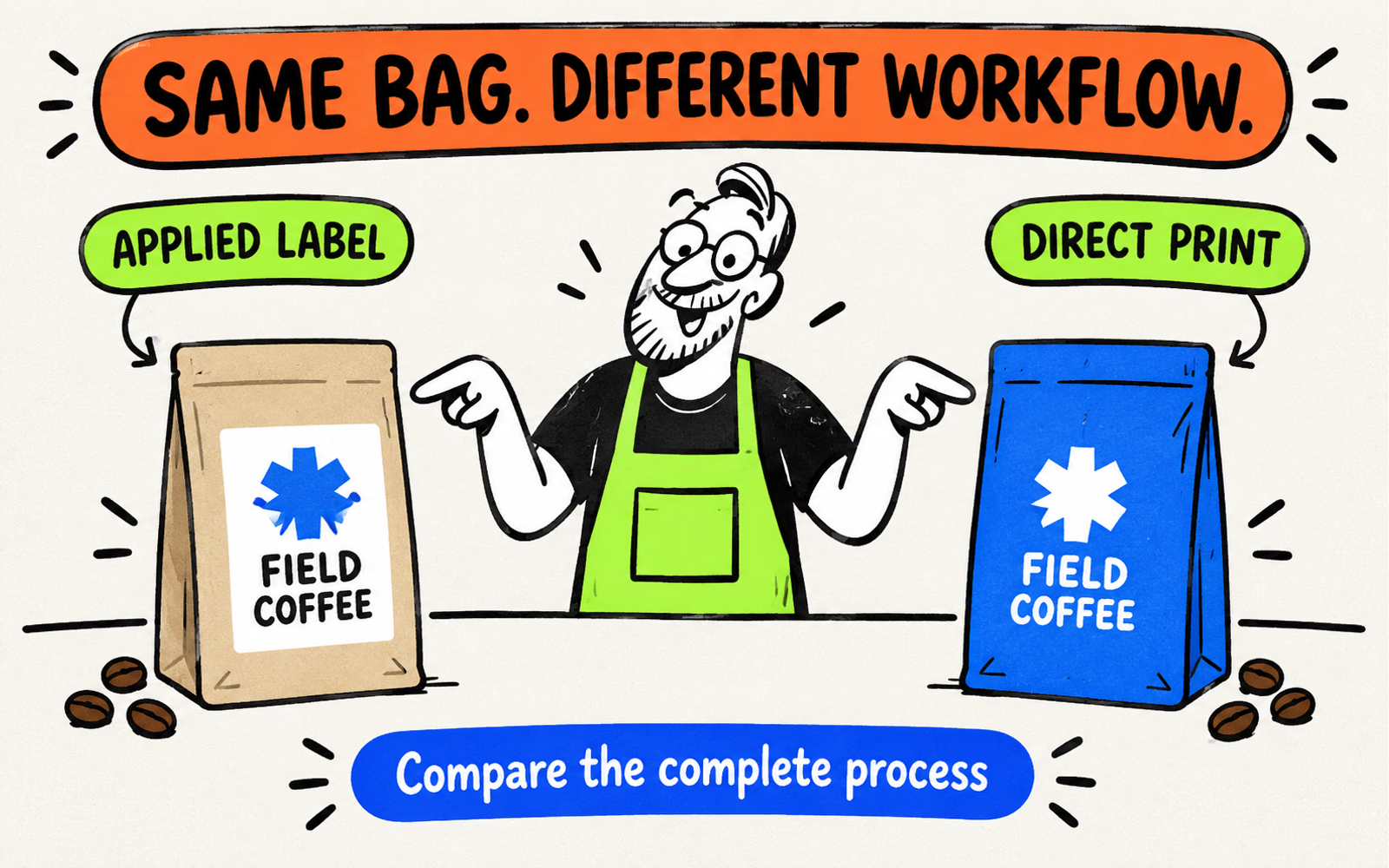
Define the same bag and product range
Start with the actual whole-bean or ground coffee, intended fill, usable dimensions, gusset, and closing process. List any valve and material requirements separately. Keep those requirements consistent in both proposals; a different pouch construction makes the print comparison harder to interpret.
Describe the retail range: one steady blend, several origins, a seasonal release, or another actual assortment. Give each design its own quantity. A combined range total does not establish a minimum for every design.
Make a shared comparison sheet
Assign one reference code to the proposed bag. Add a version list with coffee name, quantity, approved information, and expected revision trigger. Mark anything still unknown as a question. The coffee pouch specification guide helps keep structural requirements separate from appearance.
Compare direct printing with applied labels
In a labeled concept, plan the plain or branded base bag, the label construction, and where and when the label is applied. In a direct-print concept, plan the bag artwork and how any information that changes after printing will be added. Confirm which methods are feasible for the proposed surface.
| Decision | Applied label concept | Direct-print concept |
|---|---|---|
| Identity | Separate bag and label files | Artwork on the approved bag layout |
| Changing coffee details | Identify which label version changes | Identify the proposed changing-information method |
| Packing work | Placement, application, and identity check | Identity check and any separate marking step |
| Approval | Bag, label, surface, and application | Bag print and any additional marking |
A hybrid is also a question to investigate: shared printed branding with a separate variety identifier. It needs its own quote and review. No illustration confirms an adhesive match, a particular barrier, or an available print process.
Use the label surface checklist to record texture, curves, placement, application conditions, and later handling.
Account for version changes and application work
Follow one real order from receiving packaging to packing finished coffee. Note who selects the correct version, how components are stored, and what is checked before the bag moves on. Time your own work instead of borrowing another company’s rate.
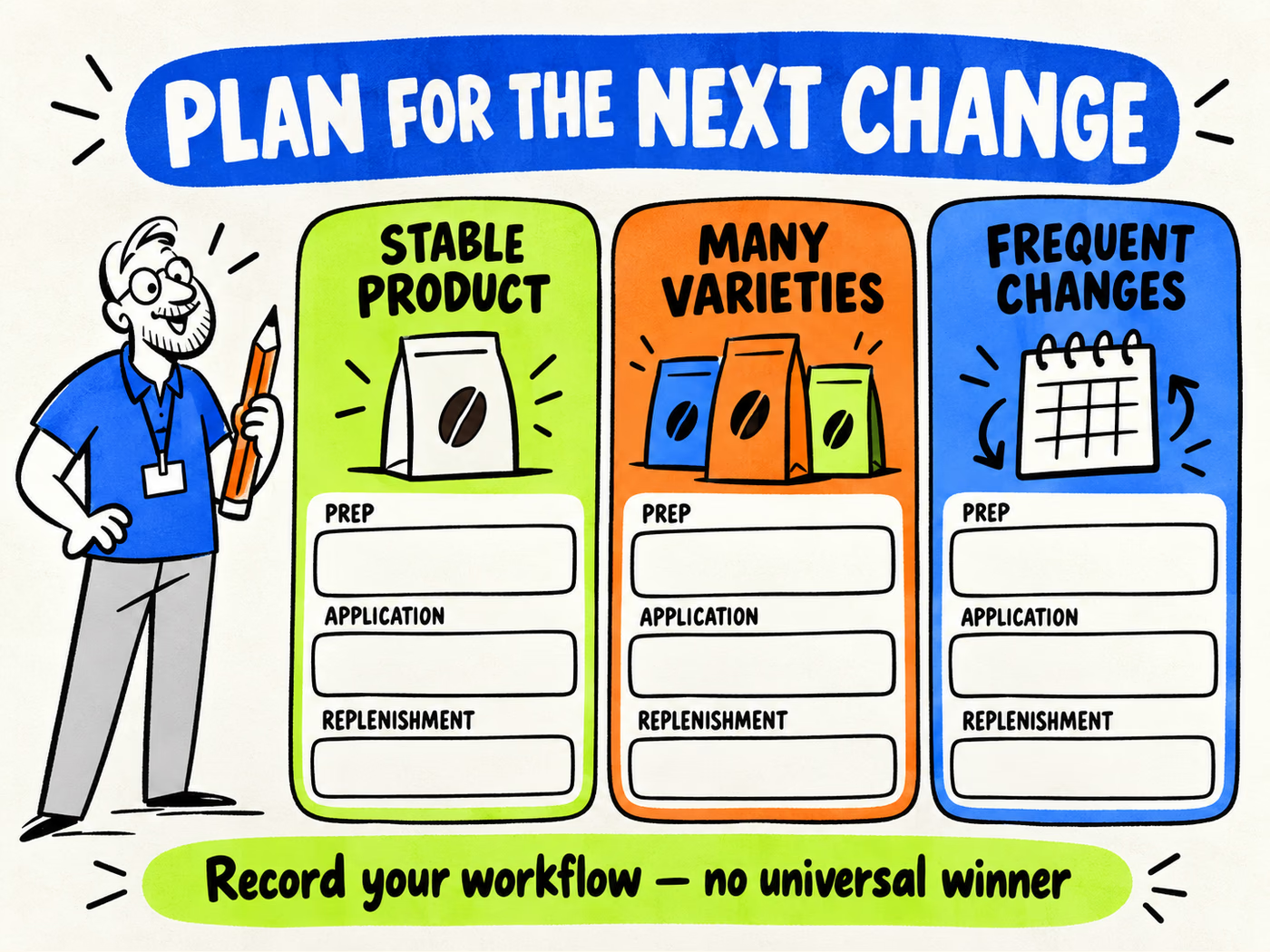
Three scenarios to record
- Stable product: Which approved bag and information can remain useful across repeat runs?
- Many varieties: How are bag, label, and quantity assignments distinguished at the packing station?
- Frequent changes: Which component becomes obsolete when a coffee or message changes?
Count usable stock by reference and artwork version. A blank bag and an obsolete variety label are different inventory positions. Equally, a printed bag with outdated content should not be counted as current simply because it is physically undamaged.
Include observed application effort, rejected units, setup, and storage in your comparison where relevant. Keep your own planning assumptions separate from quoted supplier charges. The branding cost guide explains why unit price alone can hide work elsewhere.
Request two comparable packaging proposals
Send the same product and bag brief with two clearly named artwork approaches. Request quantities per design, proposed construction, printing scope, and any separate label or marking components. Ask which costs and steps belong to each proposal.
Compare the approved proof and sample scope as well as the delivered cost. Record the production and delivery conditions actually offered. Do not assume a short run, a saving, or a lead time from the words “label” or “custom printed.”
Explore custom coffee bags and custom labels as separate references to review. For the visual identity, continue with coffee bag design ideas; this comparison focuses on making that identity repeatable in your workflow.
References & planning resources
BrandYourPack’s original planning examples and blank worksheets support project review; they are not completed trials or confirmed supplier terms.