
Recyclable vs. Compostable Packaging: Questions to Ask Before Making a Claim
Separate recycling, composting and biodegradability. Ask for evidence covering your exact packaging and check local disposal options before approving environmental wording.
Recyclable and compostable packaging describe different potential disposal routes; neither is interchangeable with biodegradable. Before making a claim, identify the exact package or component, obtain relevant evidence and check the applicable disposal conditions and access. This US-focused guide uses FTC Green Guides and EPA information reviewed October 6, 2026. A material’s appearance, supplier shorthand or certification logo alone does not approve wording for the complete package or establish what a customer’s local program accepts.
The useful question is not which word sounds better on a bag. It is what your evidence supports for the item you are selling, and what the customer can actually do with it. Work through that question before putting a claim into artwork.

Check the current US guidance and the claim’s scope
We reviewed the current eCFR text of 16 CFR Part 260 and the FTC’s Green Guides summary on October 6, 2026. The eCFR displayed Title 16 as current through October 2, 2026. This article uses the displayed guidance, not proposed revisions or consultation questions as if they were adopted rules.
The Guides explain the FTC’s views on environmental marketing claims. They do not replace applicable federal, state or local requirements. Begin by identifying the exact proposed wording, the item it refers to and the market where it will appear; route that record to the responsible claims reviewer.
| Question | Record to create | Why it matters |
|---|---|---|
| What is the wording? | Exact proposed statement | Different terms communicate different attributes |
| What does it cover? | Product, component or complete package | Prevents an unclear scope |
| Where will it appear? | Label, web page or other marketing | Keeps review tied to its context |
| Which market? | Intended sales locations | Supports the relevant requirements review |
The practical worksheet below is our own purchasing and artwork method. It is not a certificate or a complete legal determination for any proposed package. Keep the responsible review attached to the actual statement.
For a dated brand-study example of evidence boundaries, see the Patagonia guide. This article specifically distinguishes US recycling and composting claim questions rather than selecting a universal environmental winner.
Separate material properties from local disposal options
The EPA’s recycling and composting FAQ distinguishes compostable plastic from broader biodegradability and explains that composting involves particular conditions. It advises checking which local programs accept the item and asking local providers about appropriate options. A familiar material name does not answer those local questions.
Keep technical evidence and disposal access in separate fields. One asks what the exact item can do under identified conditions. The other asks whether the relevant collection and processing route is available and accepts that item. Neither field should be replaced by a leaf graphic or a vague green message.
| Term under review | Question to investigate | Avoid assuming |
|---|---|---|
| Recyclable | Which applicable collection and recovery route accepts this item? | Every local program accepts it |
| Compostable | Which conditions and facilities apply to this exact item? | Home and industrial composting are equivalent |
| Biodegradable | What evidence and conditions support the proposed wording? | A synonym for either disposal route |
Ask the disposal provider about the complete item and its condition after use. Record the provider, location, date and response. Do not turn one location’s answer into instructions for every customer or a conclusion about the entire sales market.
For packaging selection itself, review paper and poly mailer workflows. Choose the required job and evaluate the proposed materials; this claims review does not make either family automatically preferable.
Ask for evidence covering the complete package
Under the FTC summary, compostable claims need competent and reliable scientific evidence addressing all materials in the product or package. It also explains qualifications for home-composting limitations and facility access, and for limited recycling availability. Apply the actual guidance to the proposed claim rather than treating a single component’s document as approval of the whole assembly.
Request documents identifying the exact item or material version and the conditions or scope evaluated. List labels, inks, adhesives, coatings and closures alongside the main structure so the reviewer can identify coverage and gaps. The relevance of each component depends on the claim and the actual assembly.
| Record | Ask the supplier for | Keep pending when |
|---|---|---|
| Item identity | Exact material and production reference | The document identifies a different version |
| Assembly | Components and applicable scope | Only the main substrate is addressed |
| Evidence | Relevant report, date and conditions | A marketing description is the only support |
| Disposal context | Applicable route and limitations | Acceptance or access is unverified |
| Claim review | Exact wording and responsible approval | Evidence does not match the proposed statement |
Track changes that affect the record
A new label, adhesive or coating can change the assembly being reviewed. Ask whether earlier documentation still covers the revised item. Keep the change and answer with the supplier record rather than reusing an old approval by default.
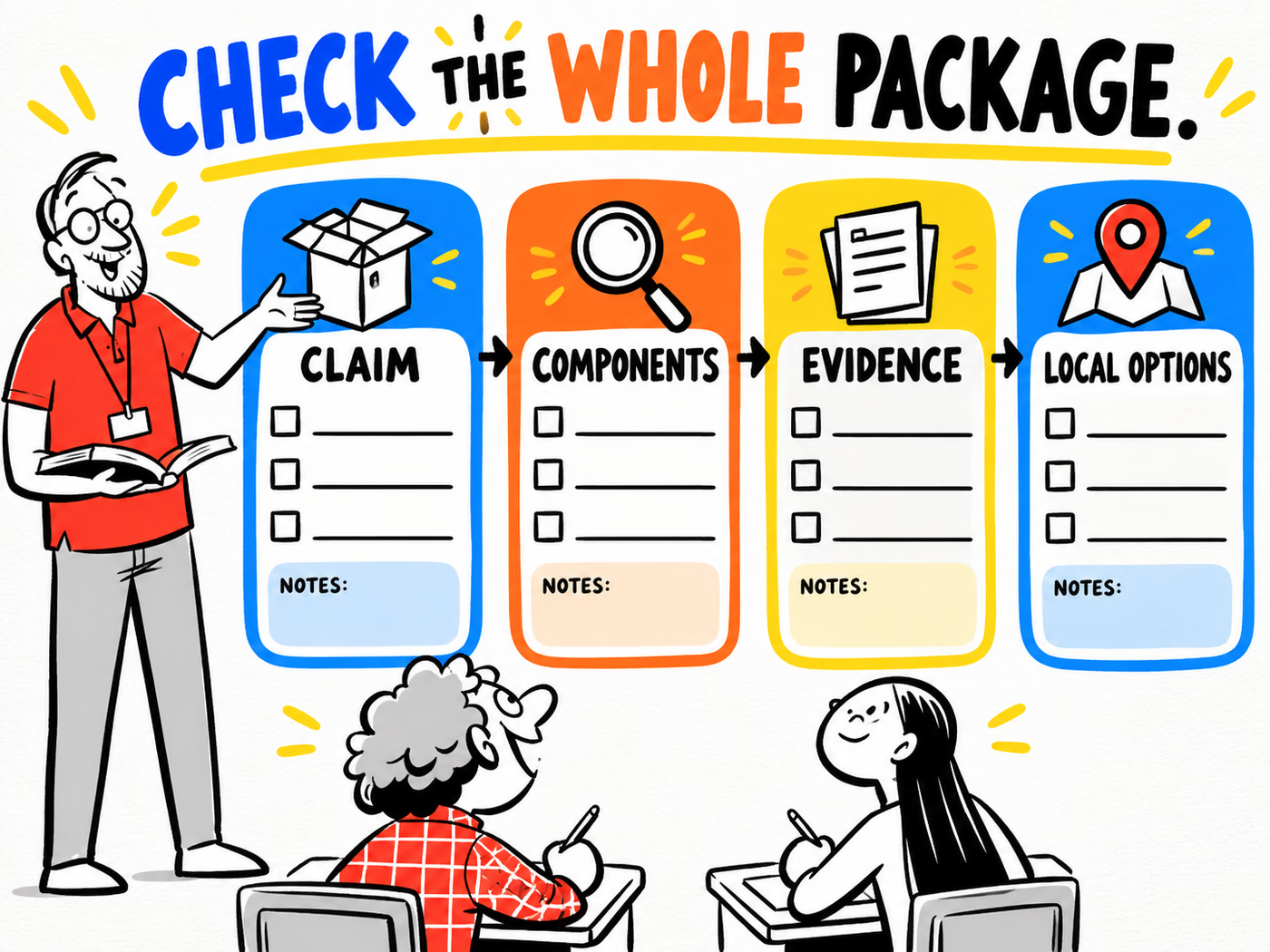
The infographic’s Claim, Components, Evidence and Local Options sequence contains empty checkboxes. It demonstrates a review process, not proof that a bag, label or carton has passed one. Define the paper’s actual use with the paper-role guide, and separate structures with the box-format comparison.
Write only claims your documentation supports
Keep unsupported wording out of the approved artwork until the relevant review is complete. When a statement is supported only for a particular component or route, record that limitation and obtain review of how it is communicated. Do not invent a generic qualified phrase and assume it fits every item.
The current Guides address clarity and prominence of qualifications and the distinction between a product, its package and a portion of either. Keep any approved limitation close to the claim and readable in the actual context. A separate document stored internally cannot explain a missing qualification to the customer.
| Stage | Working record | Approval question |
|---|---|---|
| Draft | Exact proposed wording and scope | Which interpretation is intended? |
| Evidence review | Documents and unresolved gaps | Does evidence cover this statement? |
| Market review | Applicable requirements and access context | Which limitations need communication? |
| Artwork | Approved wording and placement | Is the final presentation consistent? |
| Reorder | Current item and document references | Does the earlier review still apply? |
Discuss paper bags, labels and mailer boxes using their actual intended roles and project specifications. Product category names do not themselves establish recyclable or compostable status.
Use the artwork guide after the wording and format are agreed. Save the approved statement, supporting references, review date and exact item version together. A useful supplier handoff makes unanswered questions visible before those questions become printed promises.