
Krispy Kreme Donut Boxes: Lessons for Independent Bakeries
What documented donut assortments can teach an independent bakery about count, layout, topping clearance, and a box identity of its own.
A Krispy Kreme box is useful to study as part of an assortment: the number of donuts, their presentation, and the identity around them. Official US pages describe dozen assortments, while an archived campaign documents a themed dozen box. Neither gives an independent bakery a production specification. Build your own pack around your finished donuts, topping clearance, order count, and real handoff.
The best box idea often starts with a simple question: what should the customer see when the lid opens? For donuts, that answer needs room for glaze, decoration, and fingers—not just an attractive pattern on the lid.
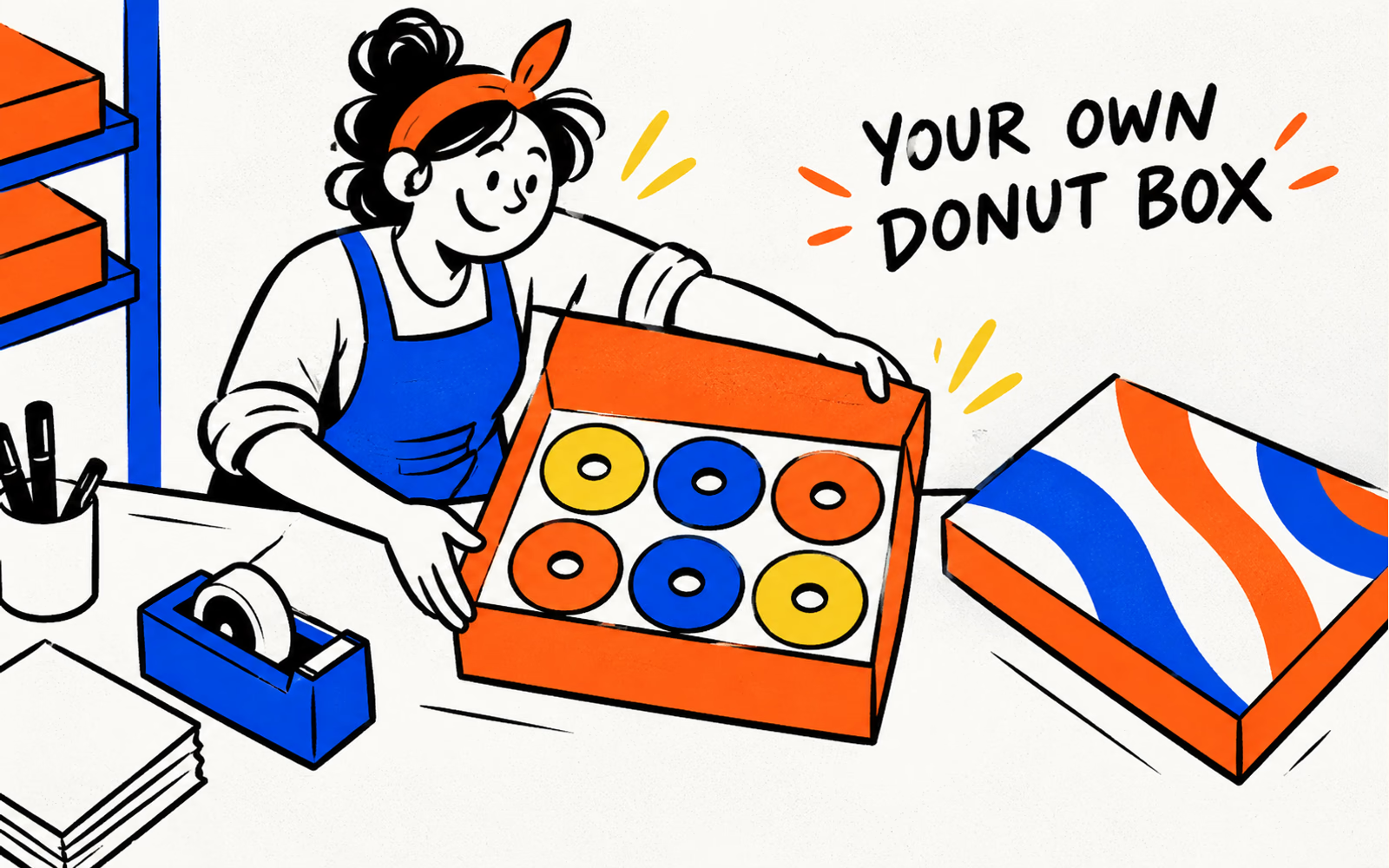
Review the documented box presentation
The official US Krispy Kreme site describes a seasonal dozen assortment. This supports the familiar idea of a group order built around a named collection. It does not establish a universal box size or arrangement for every shop, market, or campaign.
For a clearly dated example, the company’s June 2023 Stars and Stripes announcement describes individual sales and a dozen in a themed box, plus a separate grocery six-pack. That is a historical example, not an offer currently available.
Take the planning lesson, then make it your own
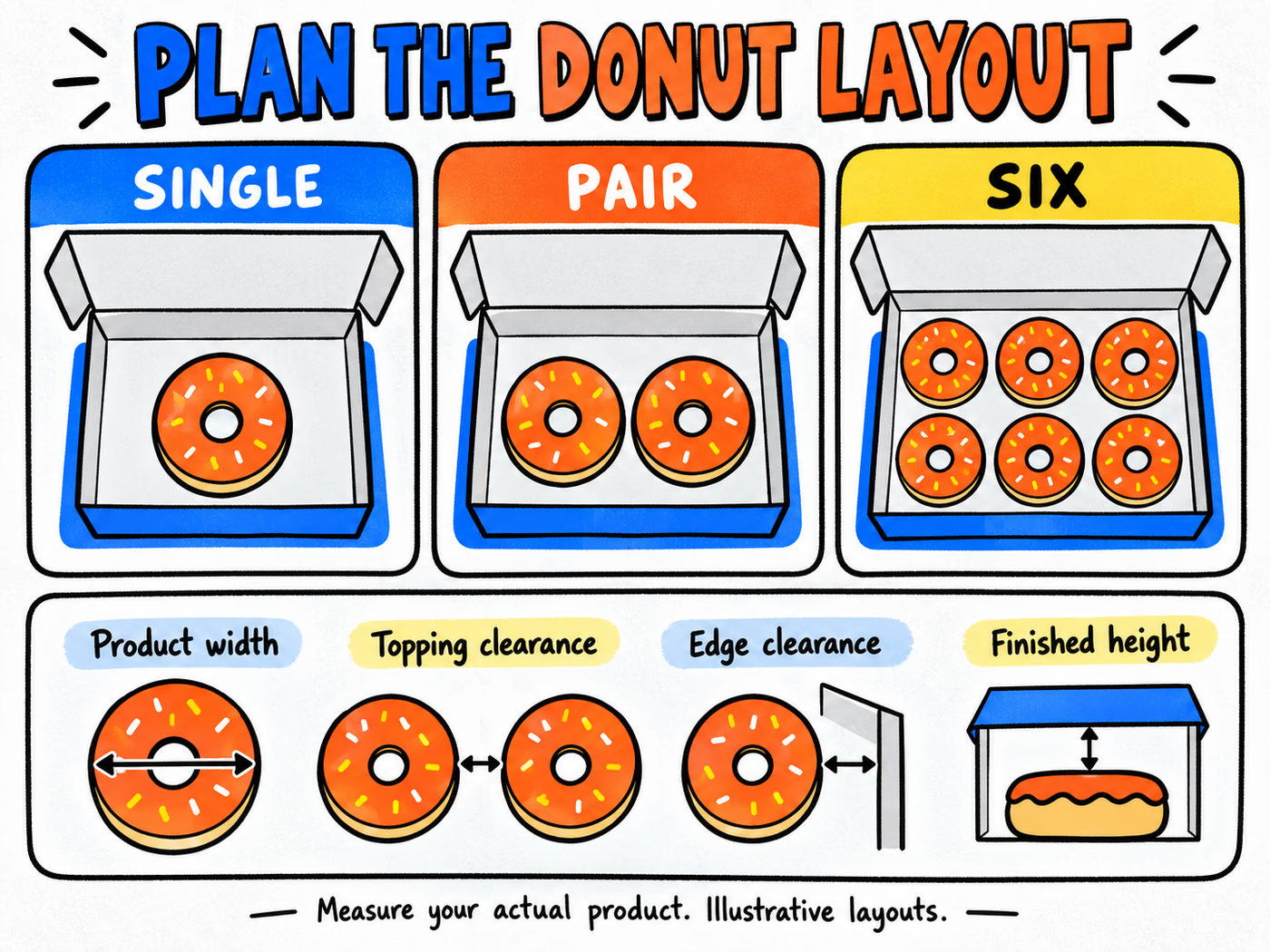
An assortment can have a consistent format while the flavors and printed theme change. For your bakery, list the counts customers actually buy before deciding how many box formats you need. A single donut, a pair for a coffee break, and a six-piece gift may deserve separate consideration.
Keep your colors, patterns, and illustrations original. The orange-and-blue striped box in this article is an independent concept. It is not a reproduction of the brand’s packaging, and its drawing does not specify board, coating, dimensions, or a supplier.
Plan a donut assortment and clearance
Measure the finished product after glaze and decoration. Include the largest diameter and highest topping you intend to sell in that format. A test with a plain ring donut may miss the clearance a decorated assortment needs.
| Order concept | Arrangement | What to measure | What to check |
|---|---|---|---|
| Single | One donut | Finished width, height, and edge space | Can it be placed and removed without rubbing the topping? |
| Pair | Two side by side | Combined footprint and gap between toppings | Do both remain separate during the handoff? |
| Six-piece assortment | Two rows of three, as one possible layout | Full row and column footprint, gaps, and highest decoration | Does the lid close without contact, and can customers lift a donut out? |
Separate product space from clearances
Sketch the donut footprints first. Add the intended space between toppings and the clearance around the outside. If an insert or divider is proposed, include it in the packed arrangement. Ask the supplier to turn that arrangement into a confirmed construction rather than treating the sketch as a dieline.
Check the tallest combination
Choose samples from the full planned assortment. A filled donut with decoration can need different space from a plain glazed ring. Note where the lid sits when closed and whether the closing step brings it across the topping.
The illustration below organizes these checks without assigning invented dimensions. For a more detailed discussion of inside measurements, use our box measurement guide.
Balance visibility with handling
Showing the assortment is only one part of the job. Staff must fill the box, close it, and hand it over consistently. Customers need a manageable pack that fits the intended carrying setup.
Decide when the product needs to be visible
An open display at the counter and a closed takeaway order have different uses. If you want a window, ask whether the proposed format supports it and what material and construction would be used. A window is a feature to evaluate, not an automatic requirement.
Walk through the complete handoff
Pack several sample orders using the intended liner, closure, and carry bag. Look for unnecessary repositioning, rubbing on decorated surfaces, and a bag that presses on the box. Review stacking and carrying with the proposed components rather than assuming a reference box’s behavior transfers to yours.
For food-contact components, describe the food and intended conditions to the supplier. Our paper comparison guide helps separate decorative presentation from a proposed food-contact use. Shipping through a parcel carrier requires a separate review of the complete shipping system.
Turn your assortment into a packaging brief
A useful request describes the order someone will pack. Send a photo of your finished donuts with measurements and a clear explanation of the intended arrangement. A reference image can explain a mood; it cannot supply missing specifications.
Include the essentials
- Donut count and the largest planned assortment.
- Finished widths and topping heights, with units.
- Preferred layout, intended gaps, and any insert questions.
- Food contact, packing conditions, pickup or delivery use.
- Closure, optional window, and carrying requirements.
- Original artwork, quantities by format, destination ZIP, and target dates.
Compare custom folding cartons and the intended paper carry bags once the filled arrangement is clear. Ask for project-specific material and construction confirmation before preparing final artwork.
For neighboring ideas, see cookie packaging formats and a coordinated holiday bakery collection. Those guides help organize a range without copying another brand’s box.
Make the assortment
your own.
Planning packaging for your food business? Tell us what you are packing, its finished dimensions, intended contact and handling conditions, quantities, and delivery ZIP.
Sources & editorial notes
- Krispy Kreme US — current official assortment presentation, reviewed October 6, 2026.
- Krispy Kreme: Stars and Stripes Dozen, June 21, 2023 — historical themed-box and format example.
BrandYourPack is independent of Krispy Kreme. The layouts and illustrations are original planning concepts; no official box dimensions, materials, supplier, or physical test results are claimed.