
Lush Packaging: Lessons for Product Wraps and Gift Presentation
Use documented Lush gift-wrap options to ask better questions about your own presentation. Keep the product’s required protection separate from the decorative outer layer.
Lush packaging offers a useful distinction between gift presentation and the protection a product needs. Its US gift-wrapping category, reviewed October 6, 2026, describes fabric wraps, paper and tins as different presentation options. Its US FAQ separately discusses protective bags for certain products. For your own solid-cosmetics gift, confirm the necessary product-contact and protective arrangement first, then design an original decorative wrap around that defined unit. A colorful paper concept does not establish material suitability or an environmental benefit.
Gift wrap can make an order feel deliberate, but it should have a clear role. Begin with the protected product, then decide what the recipient should see and how the decorative layer opens.

Choose a documented Lush packaging example
The US gift-wrapping category describes fabric wraps alongside Lokta papers and tins. This is a documented range of different presentation approaches, not a universal specification for wrapping every cosmetic product.
The US FAQ separately discusses bags used for certain unpackaged products in online orders and gifts. It also notes restrictions affecting some US online sundries. Keep presentation, protection and availability as distinct questions; the category page does not establish that every listed option is available for every purchase.
| Documented option | Planning question for your brand | Still needs confirmation |
|---|---|---|
| Decorative wrap | What should the gift look like? | Exact proposed material and artwork |
| Container or protected unit | What holds the product? | Product compatibility and fit |
| Gift assortment | Which pieces belong together? | Actual packed arrangement |
Our interpretation is that a gift can have a recognizable outer appearance while preserving the product’s separate physical requirements. We do not repeat environmental percentages or transfer Lush’s material claims to another supplier. Our qualitative search review provides no keyword volume or ranking estimate.
The fictional illustration uses abstract patterns and generic solid-product shapes. It does not copy Lush artwork or depict an approved contact material. For the separate information-hierarchy problem, read the Aesop guide.
Separate product protection from decorative wrapping
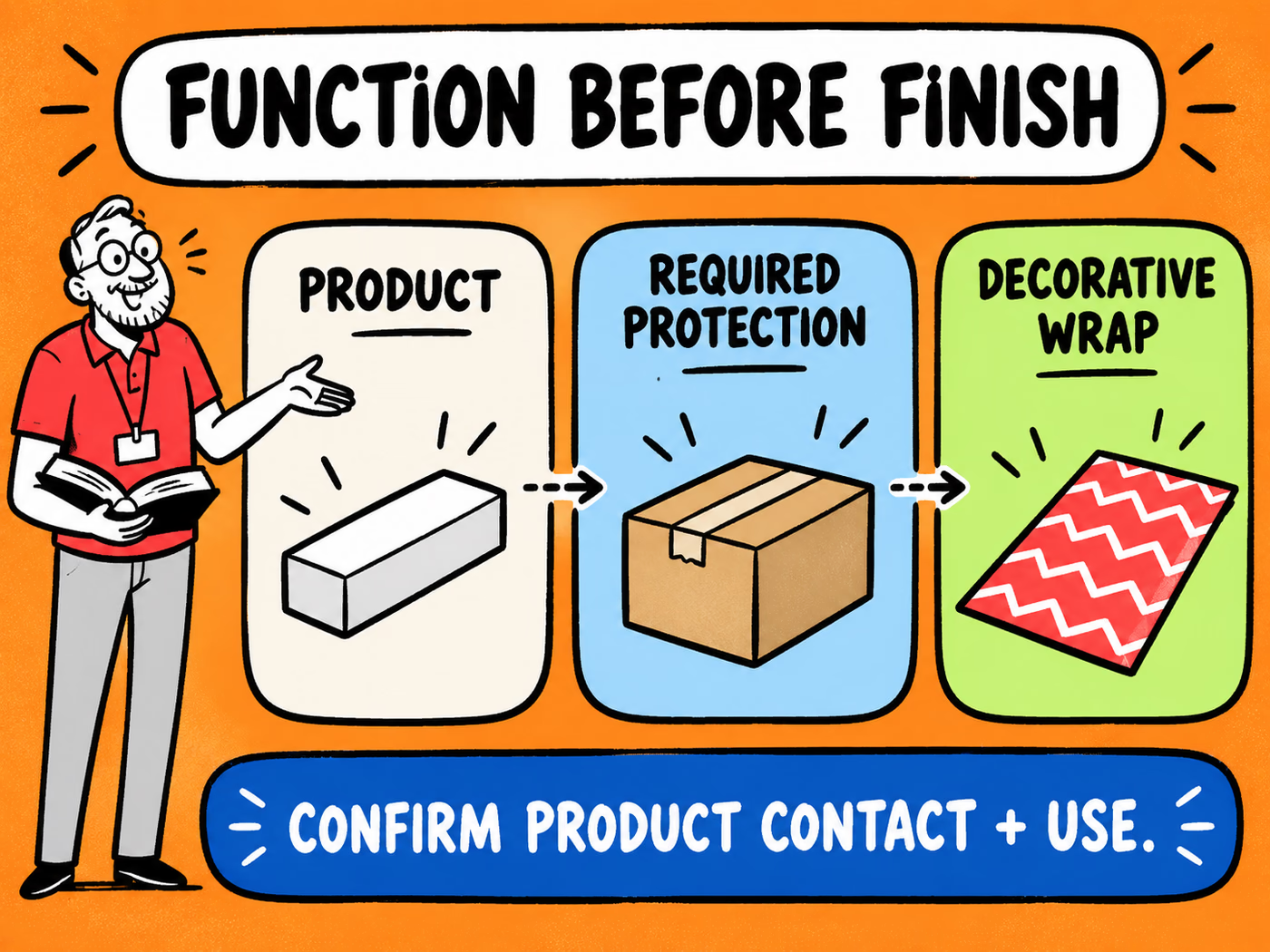
Draw the arrangement as three decisions: the actual product, the protection or contact packaging it requires, and the decorative layer visible to the recipient. The middle decision must come from the actual product and use. Gift appearance cannot settle it.
For the illustration, a generic solid item is shown separately from a closed unit carton and a patterned sheet. The separation makes the roles visible; it does not mean that a plain carton alone is sufficient protection for your item.
| Layer | Question to settle | Do not infer |
|---|---|---|
| Product | What exact item and conditions are involved? | Every solid cosmetic behaves the same |
| Required protection | What confirmed arrangement is suitable? | A decorative paper is approved for direct contact |
| Decorative wrapping | How will the protected unit be presented? | A pattern provides protection or proves sustainability |
Review the material touching the product
Identify every surface that contacts the item and every layer that stays with it during storage or delivery. Ask the responsible product team and supplier what evidence is needed for that use. Record the answer for the exact material rather than a generic name such as “gift paper.”
A colored sheet placed around a closed, confirmed unit may have a different role from a sheet touching the bare product. Keep that distinction in the brief, photographs and approval record. The infographic is a planning map, not a validated packing method.
Build an original gift presentation
Start with the contents: one item, a pair or a defined assortment. Arrange the complete protected units together, then choose the decorative approach. A wrapper, a sleeve and a gift box create different opening sequences and need different physical dimensions.
For a two-item gift, decide whether the recipient sees both units together or opens them one at a time. Use a clear card or label to explain the assortment if that is useful. Keep approved product information with the corresponding item rather than treating decorative copy as a replacement.
| Gift arrangement | Useful design question | Record to keep |
|---|---|---|
| One protected unit | Does a simple wrap add a clear gift moment? | Wrap size and opening approach |
| Two related units | How are the pieces grouped? | Complete arrangement and identification |
| Defined assortment | What should be seen first? | Layout and message hierarchy |
Develop an original pattern that works on the proposed printable area. Review how it folds around the actual unit, where the closure sits and whether the identity remains visible. A full-page flat pattern can look quite different once wrapped.
Explore wrapping paper, labels and product boxes after their roles are defined. The gift-wrap versus gift-box guide helps compare the opening and presentation choices.
Confirm materials for your product’s actual use
Provide the supplier with the intended role, product arrangement, storage and delivery context. Keep the contact packaging requirement explicit. Ask for the proposed material and construction details, then record what is confirmed and what needs further review.
Avoid treating a brown color, a thin sheet or a small amount of wrapping as evidence of an environmental result. If you want to communicate a material claim, obtain documentation for the exact item and scope before approving that wording. A different brand’s statement is not documentation for your order.
| Brief field | Confirmation needed | Working record |
|---|---|---|
| Contact role | Which surfaces touch the item? | Actual material and use |
| Structure | How does the complete unit fit? | Packed dimensions and template |
| Appearance | How do print and folds interact? | Original file and proof review |
| Claim, if proposed | What evidence supports the exact wording? | Document, scope and reviewer |
Measure the complete protected arrangement with explicit units and use the measurement guide to keep inside and outside dimensions distinct. Prepare original artwork against the agreed template using the artwork guide.
Keep quantities, versions and delivery ZIP connected to the brief. Save the approved decorative treatment alongside the confirmed protective arrangement so a reorder preserves both decisions. A change in product or contact layer should trigger a fresh review before repeating the gift wrap.