
Tissue Paper vs Greaseproof vs Wrapping Paper
Choose tissue, gift wrapping, or food-related paper by its actual job. Review the proposed material, print, folds, contact conditions, and sheet count.
Tissue paper vs. wrapping paper is best compared by function: tissue often adds presentation around a retail item, while wrapping paper covers a gift or purchase. Greaseproof applications raise separate questions about the food, exposure, material, and printing. None of these names proves that a particular sheet is suitable for the intended contact or handling. Define the job first, then review the proposed specification.
A shirt inside a mailer and a takeaway burger need different briefs, even if their paper has the same color. A useful comparison makes those differences visible before choosing a pattern.
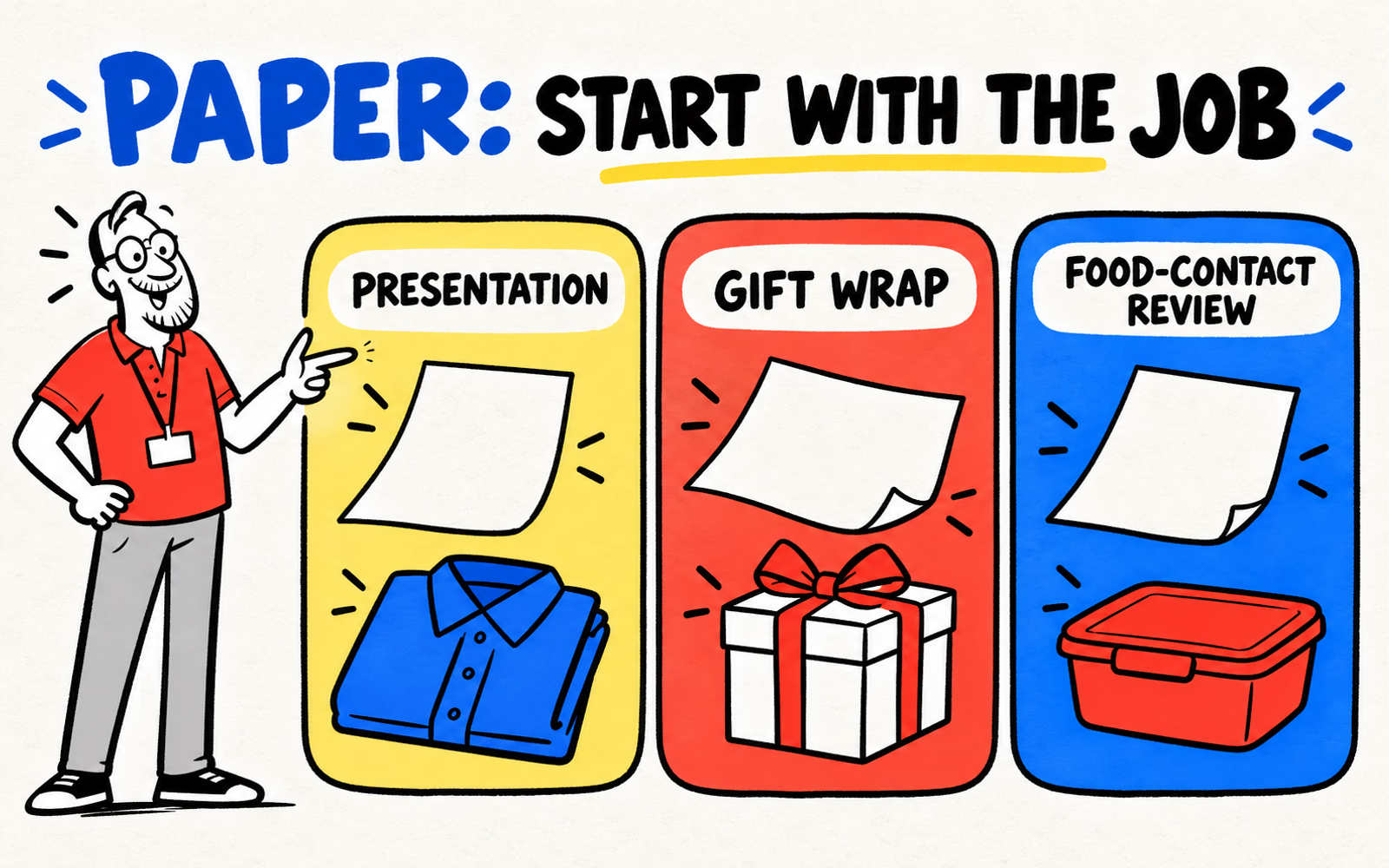
Identify the paper’s job in the package
Describe what happens to the paper in one ordinary sentence: “We fold it around a shirt,” “We wrap a boxed gift,” or “We need a liner for this serving arrangement.” Include the item, the layers already around it, and what the paper touches.
Separate three decisions
- Presentation: which surfaces the customer sees and how the pack opens.
- Protection: what actual barrier or holding requirement needs review.
- Contact: whether food or a sensitive product surface touches the proposed sheet or print.
A decorative layer can have a clear visual job without replacing the product’s required primary packaging. Keep that distinction in the sketch. The cover shows a closed primary food container beside a separate paper-review concept, rather than suggesting decorative printing is approved for food contact.
For apparel, review the complete presentation plan. For food service, start with the contents and intended handling. Identify any outer box separately with the box-format guide.
Compare tissue, wrapping, and food-contact needs
Use material names as categories to investigate. A translucent appearance, brown color, or printed logo cannot supply the specification you need.
| Application | Starting role | Record before choosing |
|---|---|---|
| Tissue presentation | Wrapping a retail item inside its pack | Actual sheet, folds, visible area, product surface, and print |
| Gift wrapping | Covering a gift or retail purchase | Finished arrangement, coverage, overlaps, closure, and design repeat |
| Greaseproof-related use | Food wrapping or lining where grease exposure matters | Food, contact, time, temperature, moisture, material, and print documentation |
Compare the complete arrangement
Wrap or fold a sample around the actual item to review coverage and assembly. Record the sheet count, the overlap, and any label or closing component. A tidy fold is an observation about that arrangement; it does not establish a barrier rating or contact suitability.
A burger wrap and a basket liner also have different coverage questions. Use the wrap-versus-liner comparison and finished-food measurement method for their respective briefs. For a meal, identify the primary container before assigning a role to an outer brand layer.
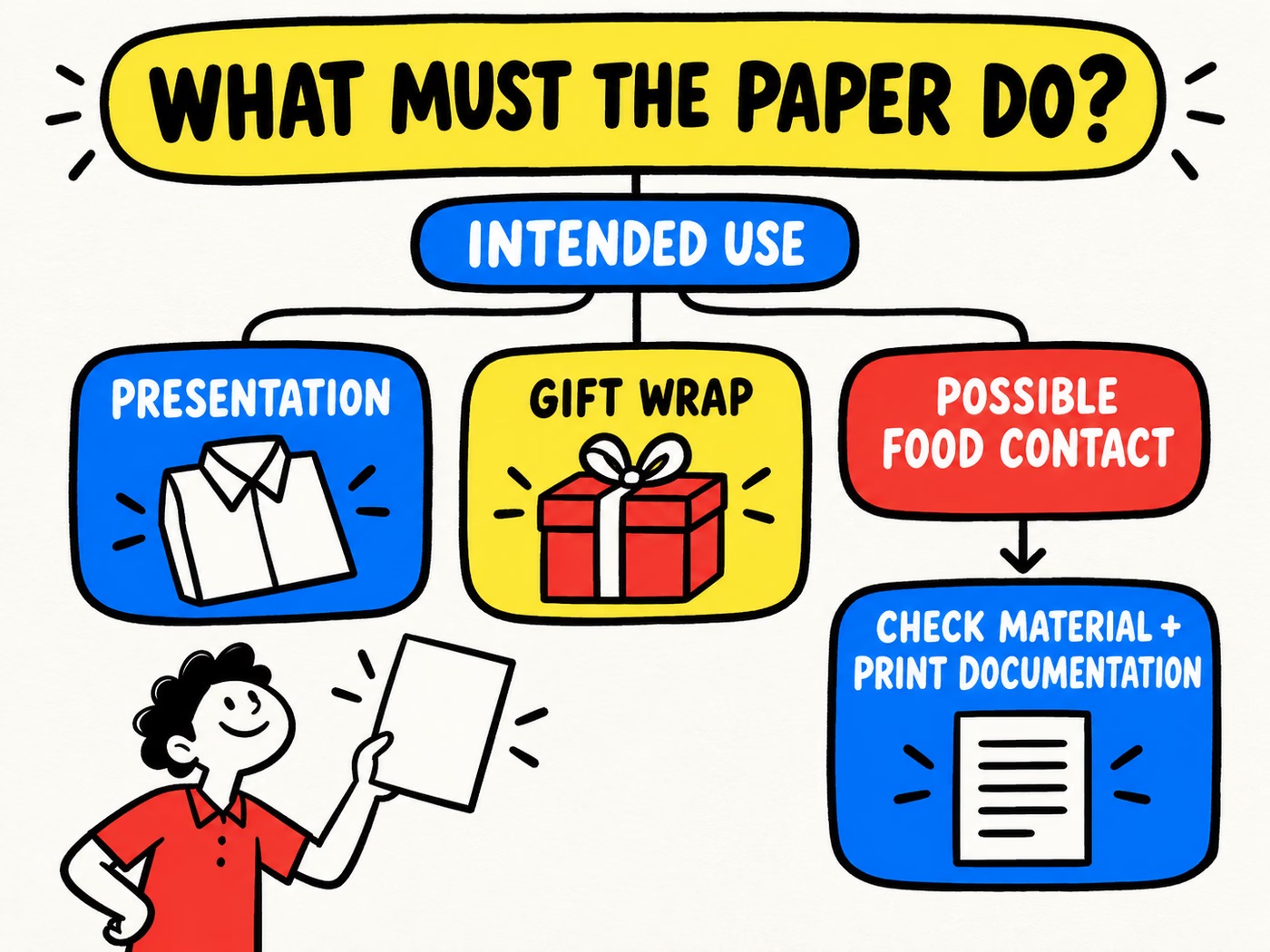
Check the actual material documentation
Ask for the proposed reference and its material description. Note the sheet format, treatments or coatings, print arrangement, and intended application. Keep a reference-specific record rather than filing everything under “paper.”
Where food contact is intended, state what touches the sheet, for how long, at what temperature, and with what oil or moisture exposure. Request the relevant material and printing documentation for those conditions. Do not infer suitability from kraft color, a decorative image, or the category name.
Custom greaseproof paper is listed in the current catalog. That confirms a format to discuss, not approval of every proposed food application. Confirm the actual construction, printing, availability, and intended-use documentation before selecting it.
Keep sample observations reproducible
Use the sample checklist to record the reference, contents, folding process, and observations. If the sheet, ink, or intended use changes, review whether the previous information still applies. No performance test results are claimed in this comparison.
Choose the paper and print for your use case
Compare tissue paper, wrapping paper, and labels by the job assigned to each. Ask for the proposed print layout after the format and dimensions are agreed.
Look at the folded pattern
Choose whether the identity is centered, repeated, or aligned with the folds. Review the actual visible area: a logo on a flat sheet may disappear under an overlap. Record the preferred repeat and orientation with the artwork, using the artwork guide for the approved layout.
Plan quantities by application. Count sheets for each wrapped item, lined serving arrangement, or retail presentation using your own packing observations. The consumption calculator can help deduct stock and round to confirmed supplier pack sizes; its examples do not establish prices or production minimums.
Keep the food-truck brief with the service plan. Your final request should name the contents, paper role, sheet dimensions, print versions, quantities, delivery destination, and any unresolved contact or handling question.