
Etsy Packaging Costs: How to Plan Your Per-Order Budget
Calculate the physical packaging cost of one Etsy order with your own component, preparation, setup, and waste inputs. Includes a blank CSV worksheet.
To plan Etsy packaging costs, list the materials used in one complete order, calculate their delivered cost per usable unit, and add your recorded preparation work. Include relevant setup costs and account for waste once. Keep this physical packaging budget separate from postage and Etsy selling fees, then compare packing options using the same product and order quantity.
The useful number is your own cost for a clearly defined order. A low box price tells you little if the order also needs paper, a label, an insert, and time to assemble it. This guide gives you a worksheet method without invented supplier prices.
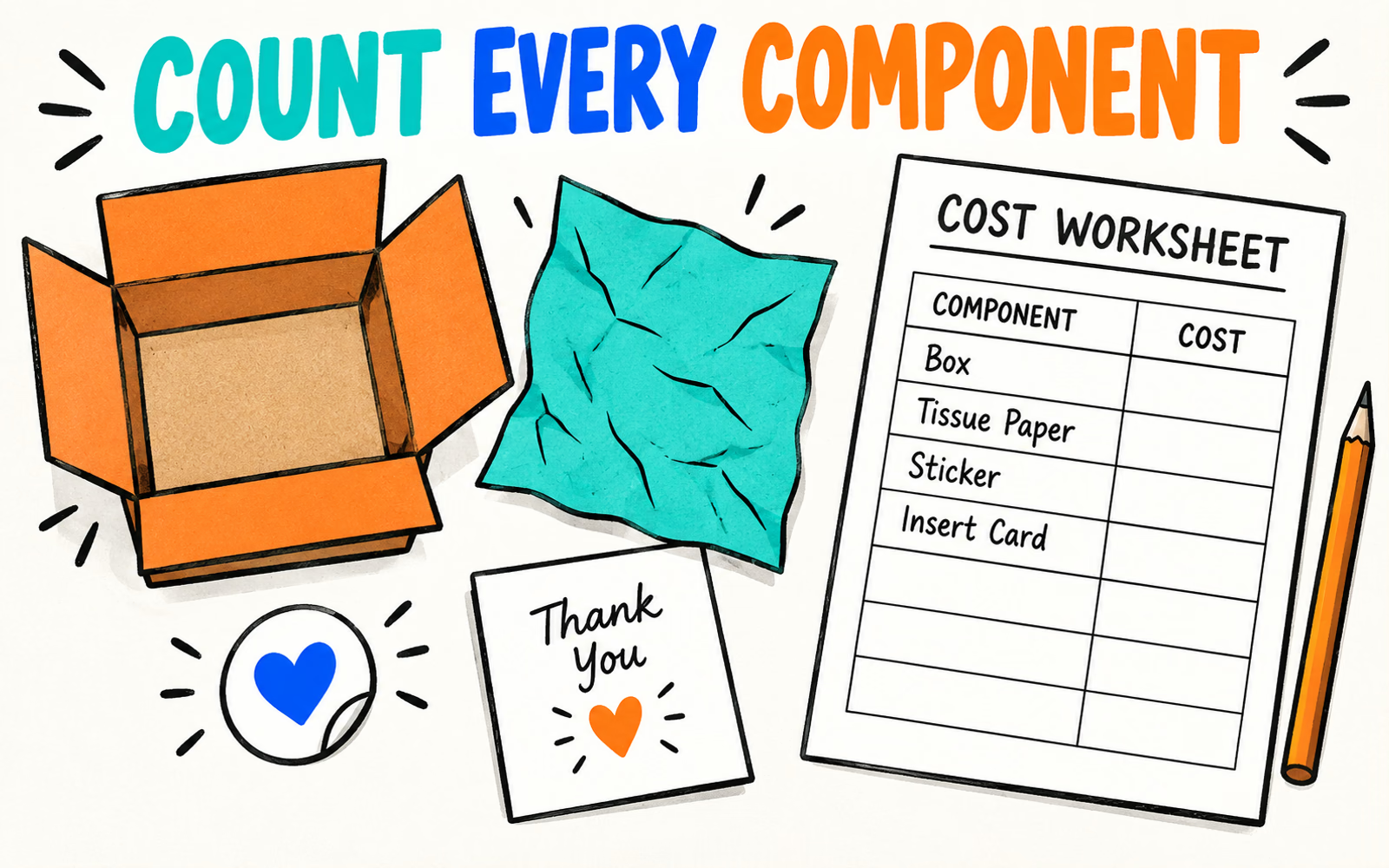
List the packaging used in one order
Pack one typical order and lay out every material used. Record quantities precisely: one box, one sheet, one label, one card, and any protection required by the product. If the design uses two stickers, enter two rather than treating “stickers” as a single flat cost.
Define the order before comparing it
Keep the product, required protection, and intended shipping journey consistent across your alternatives. A single-item order and a gift bundle need separate worksheets if they use different components. Use the Etsy packaging planning guide to organize the physical kit.
| Input | What to record | Where it comes from |
|---|---|---|
| Material | Exact reference and quantity used per order | Your packed sample |
| Delivered component cost | Purchase cost plus allocated inbound delivery, on a consistent tax basis | Supplier quote or invoice |
| Usable units | Units available for the intended orders | Received stock and observed waste |
| Preparation work | Recorded minutes per order and your internal hourly rate | Your packing observations |
| Setup | Relevant one-time cost and allocation quantity | Project quote and your order plan |
Keep unknown values blank and label them pending. An unconfirmed delivery charge or missing setup item should not silently become zero.
Calculate a transparent per-order total
For each component, use delivered component cost ÷ usable units × units used per order. Add the component lines to get the material total. Allocate a shared inbound delivery charge consistently, and make sure it is not also included in a second total.
Add preparation and setup explicitly
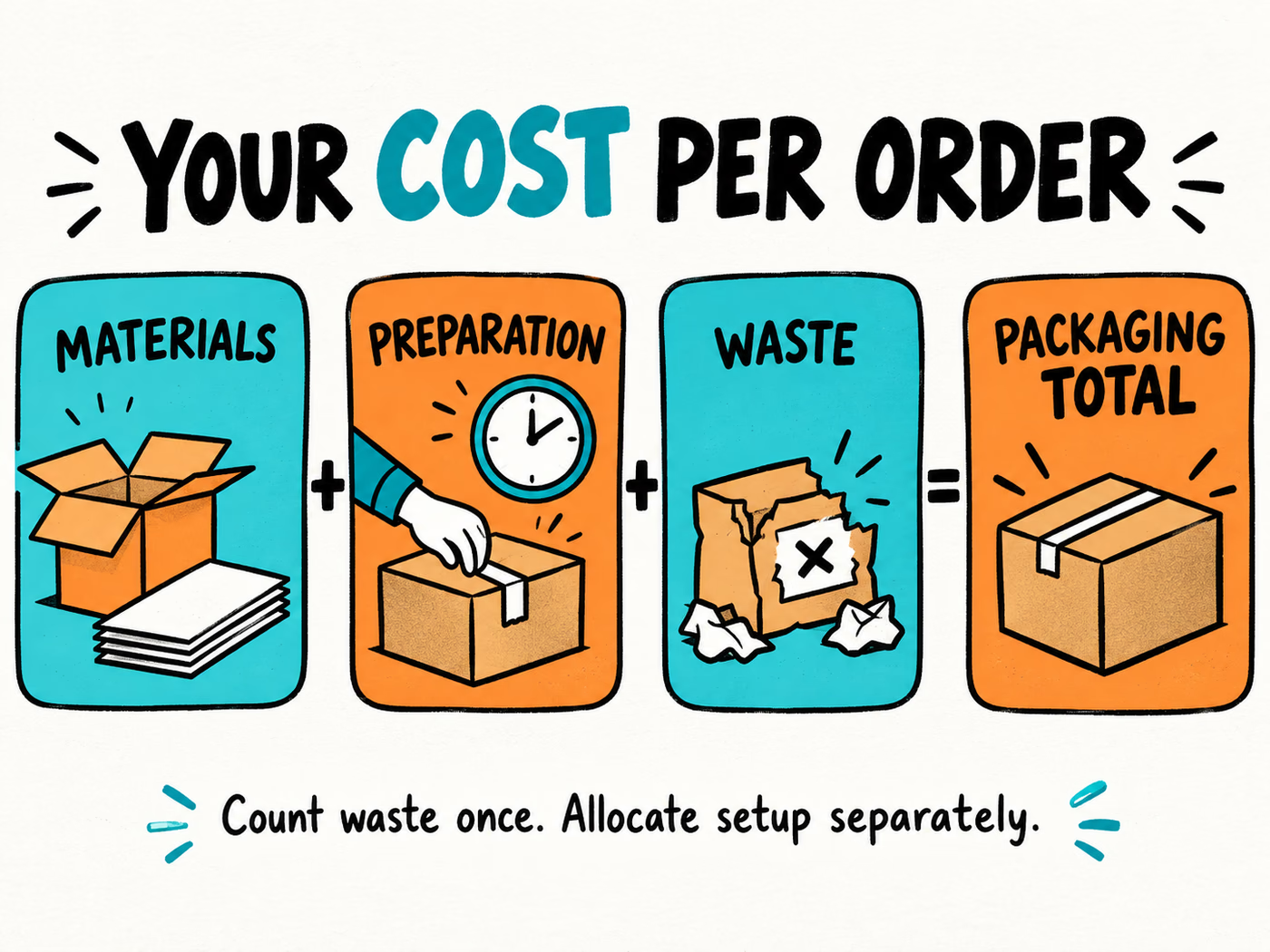
Record the time taken to prepare representative orders using the proposed process. Convert your average minutes to hours before multiplying by your internal hourly rate: minutes per order ÷ 60 × hourly rate. Include the actual tasks you want to compare, such as assembling the box, wrapping the item, and applying the label.
For a relevant setup charge, use setup cost ÷ the number of orders you intend to allocate it across. Record that quantity as an assumption. If a supplier has already included setup in the component total, do not add it again.
Count waste once
You can account for waste by dividing the purchase cost by a reduced usable-unit count, or by using the purchased-unit count and adding a separate waste allowance based on your observations. Choose one method for each input. Combining both can count the same lost units twice.
Your packaging total is the material total plus preparation, separately allocated setup, and any waste allowance not already included. Carrier postage and marketplace charges belong in separate lines in your wider order budget.
Download the blank packaging-cost worksheet (CSV). Open it in your spreadsheet app, enter your figures in a consistent currency, and use the method column to build your calculations. It contains blank inputs rather than price assumptions or automatic formulas.
Compare simple and more elaborate setups
Build two versions of the same order. A simple version might use a suitable box with a single useful insert. A more elaborate version might add coordinated tissue and an applied sticker. Retain the protection the product requires in both versions.
| Question | Simple setup | Added presentation |
|---|---|---|
| What changes? | Record the base components | List every added component and its job |
| How much work? | Observe the base process | Observe the extra folding, placement, and application |
| What becomes unusable? | Record losses by reference | Also track design-specific leftovers |
| What helps the buyer? | Identify useful information and opening experience | Check whether each addition improves that experience |
Use the sticker-versus-printed-box comparison when those are your two routes. Do not assume either is cheaper until the complete proposals and your own work inputs are available.
Keep Etsy fees outside this worksheet
Etsy documents marketplace fees separately from physical packaging expenses. Its current help page also explains that handling and package fees have been removed from calculated shipping. Do not build your plan around adding that former charge field; review the current Etsy handling and package fee guidance when considering how costs fit into listing prices.
Use your real numbers to request quotes
Send the product’s packed dimensions, intended use, component list, artwork versions, quantities, and delivery ZIP. Ask the supplier to identify included setup and delivery items so the quote can map cleanly to your worksheet.
Evaluate mailer boxes, stickers, and insert cards against the same order. Use the measurement guide for fit and the artwork guide for version preparation.
Replace assumptions with received quotes and observed packing data as they become available. Keep the worksheet dated, so a changed quantity or design does not get compared with an outdated input.
Know the full kit.
Plan with your own numbers.
Planning your own mailer boxes? Share the packed-product dimensions, intended use, artwork versions, quantities, and delivery ZIP for a project-specific quote.
Sources & worksheet method
- Etsy Help: Updates to Handling and Package Fees.
- Etsy Help: Fees and Taxes for Selling.
- BrandYourPack: Custom Packaging Cost Factors.
Reviewed October 6, 2026. Original worksheet method with user-supplied inputs. No supplier prices, savings benchmarks, or standard labor rates are assumed.