
What Affects Custom Packaging Cost?
Understand the complete scope of a custom packaging quote. Separate format, quantities, print, setup, and delivery, then compare equivalent specifications.
How much does custom packaging cost? The useful answer comes from a quote for the complete specification: format, dimensions, construction, material, print areas, finishing, artwork versions, quantities, and delivery. Compare the full included scope and total purchase, then relate it to the quantity you need. There is no automatic price in this guide; BrandYourPack confirms pricing for your actual project.
A unit price is meaningful only when you know what it covers. This expanded guide shows how to read a quote, separate its inputs, and request alternatives that answer the same question.
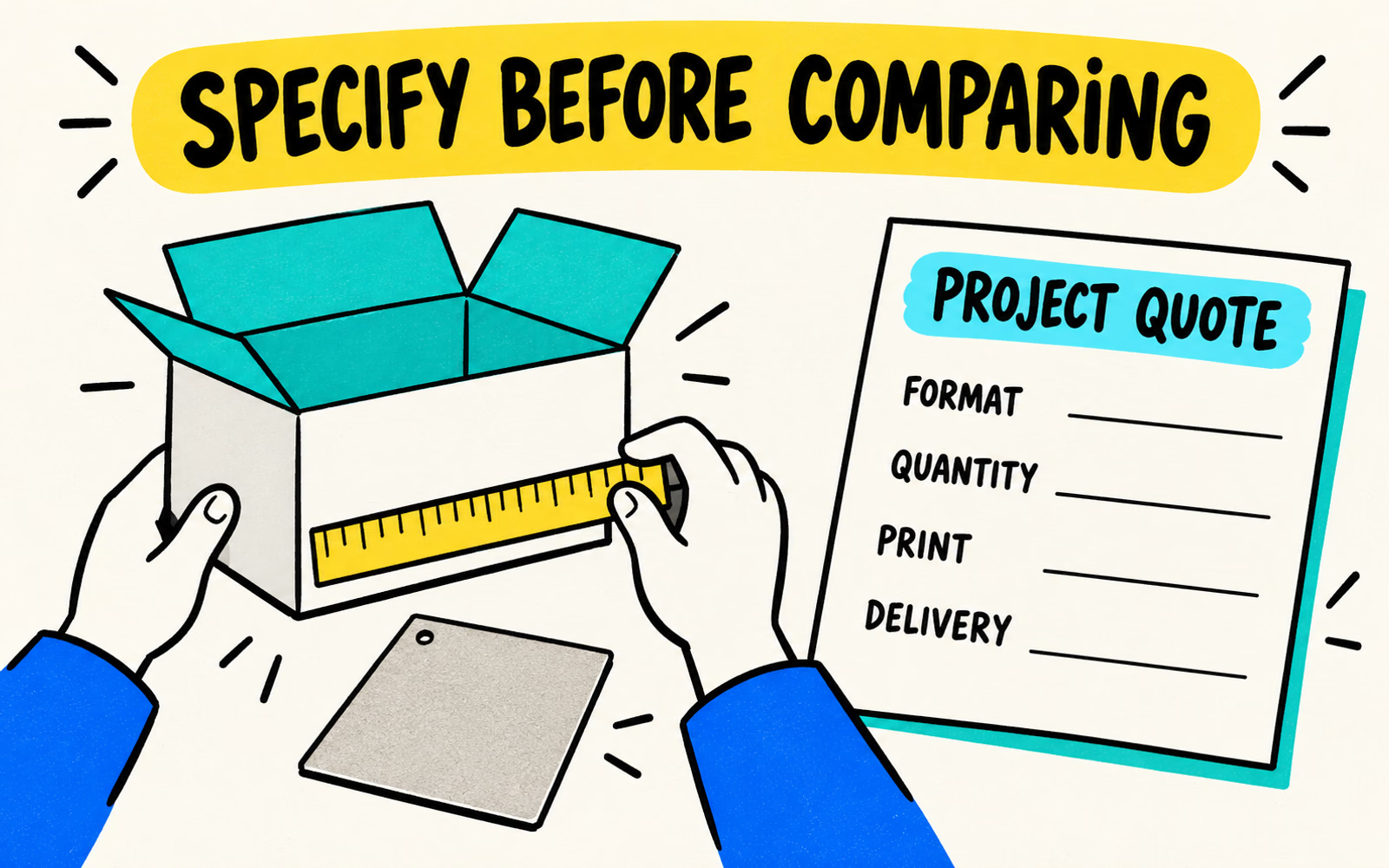
What a custom packaging quote includes
Begin with the physical packaging specification. State what will be packed, its finished dimensions, the proposed opening style, and the intended use. Identify any presentation insert, support, or protective packaging as a separate component requiring confirmation.
Read the scope before the price
Ask the supplier to describe the proposed construction and material, printed panels, artwork versions, and quantities. Confirm whether the proposal includes inside printing, special finishes, separate components, or assembly. A similar product name does not make two proposals equivalent.
Clarify applicable charges
- Which setup, artwork, tooling, sample, or proof charges apply?
- Are those items already included in the component total?
- Are delivery charges included, and to which destination?
- Which requested components or services remain outside the quote?
- Which changes require a revised quote?
- What production and delivery dates apply after approval?
Use the written proposal as the source for each amount. If a charge is unclear, mark it pending and ask for clarification. Do not treat an unconfirmed cost as zero or assume that a listed charge is always required for every format.
Separate format, quantity, printing, and delivery
Organize the variables so you can see which part of the project changes between proposals. A quote may combine several charges into one line; record that inclusion rather than inventing a breakdown the supplier has not provided.
| Variable | Specify | Check in the quote |
|---|---|---|
| Size and construction | Internal fit, contents, and opening style | Included supports, inserts, and protective packaging |
| Material | Intended use, handling, and presentation | Actual material description and suitability for the use |
| Printing | Printed panels, colors, and artwork designs | Inside print, finishes, and applicable setup |
| Quantity | Units per size and artwork version | Confirmed minimums and run constraints by reference or design |
| Delivery | ZIP, requested timing, and delivery scope | Included freight and separate production and transit information |
Keep quantity splits visible
A total order quantity does not describe how it is divided across sizes and designs. List each run separately. Ask the supplier to confirm the actual commercial constraints instead of assuming that every combination can use one shared minimum.
Separate quote cost from your packing work
If your own team assembles boxes, wraps products, or applies labels, record that work separately in your internal comparison. It is not automatically part of the supplier quote. The per-order packaging worksheet explains how to organize your own materials, preparation, setup, and waste inputs.
The categories below are blank fields for reading an actual proposal. They do not assign prices, standard percentages, or required charges to your project.
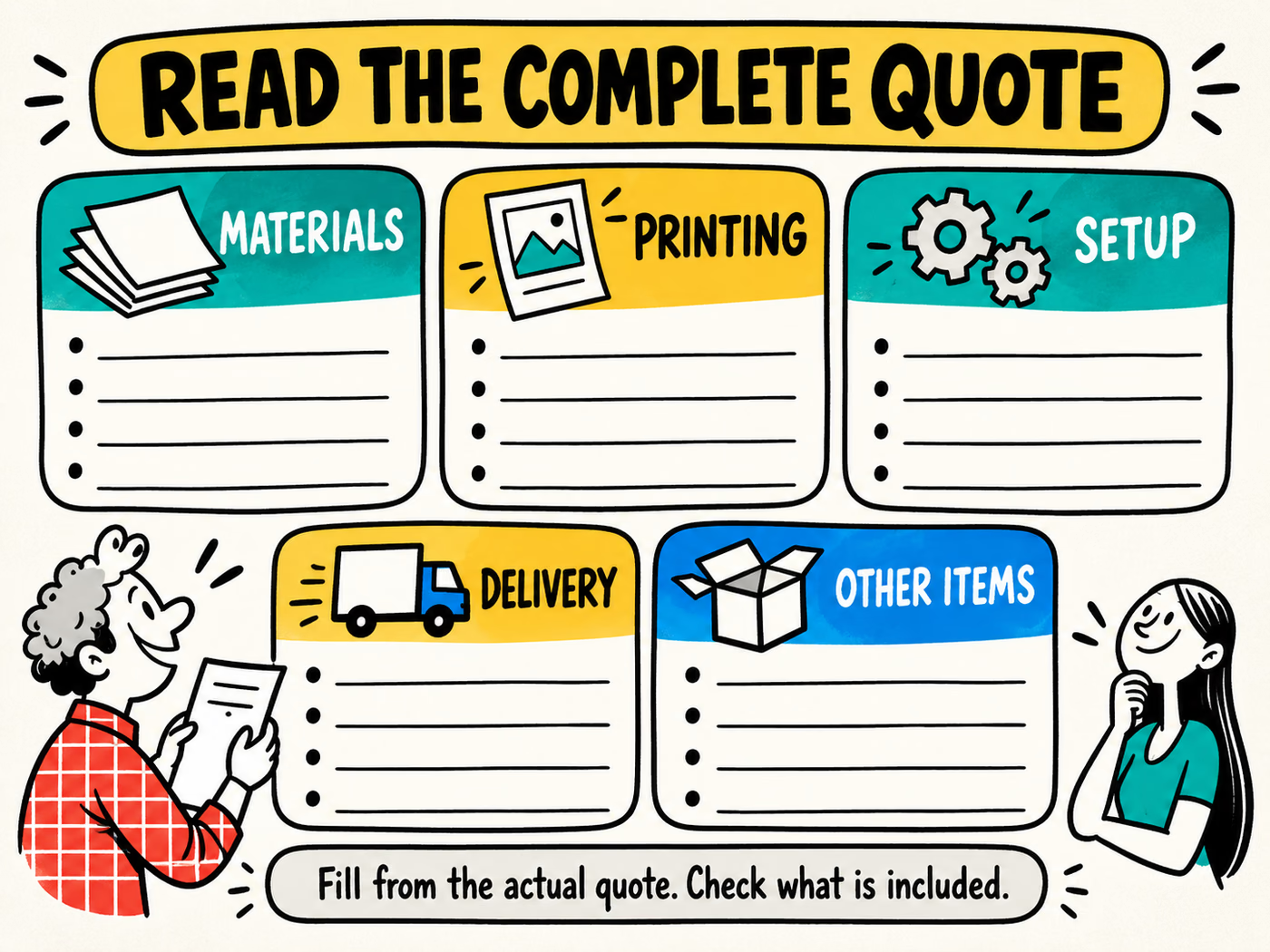
Compare quotes on an equivalent specification
Align the proposed construction, material, dimensions, print scope, quantity split, added components, and delivery destination. If a proposal changes one of them, show the difference explicitly before comparing totals.
A scope comparison without invented prices
Suppose two illustrative quotes describe 500 mailers. One covers exterior printing only; the other covers inside and outside printing and includes an insert. They are not directly comparable even if the box dimensions match. First align the construction, printed areas, insert, and delivery scope, then compare total and unit price. This is a hypothetical scope example, not a current price, actual supplier quotation, or available order minimum.
Change one defined choice at a time
If your budget is uncertain, request two versions of one specification. For example, keep the same dimensions and quantity while comparing exterior-only print with inside-and-outside print. Ask whether either option changes setup, artwork preparation, or shipping. The difference then relates to a defined choice.
For stickers versus directly printed packs, use the complete-order comparison. Compare the same use requirements and include the work and stock implications relevant to each route.
Compare total purchase as well as unit price
A larger order can have a lower quoted unit price while requiring a higher total purchase, more storage, and more unused stock. Compare the full delivered total with the quantity you expect to use. Record the chosen quantity and any waste or stock assumptions rather than treating unit price alone as the decision.
When you use the total-cost comparison calculator, read its method and exclusions, then enter your own confirmed inputs. Its example values are assumptions, not BrandYourPack prices.
Prepare the information needed for a useful price
Use the quote checklist to write a request containing the complete packed-product dimensions, intended use, construction questions, artwork versions, quantities, and delivery ZIP. Add the requested timing and identify any samples or approvals you need.
Evaluate mailer boxes, folding cartons, or labels against the actual job. The catalog helps you identify formats, while the quote confirms the project-specific proposal and terms.
Prepare files with the artwork guide once the print areas are agreed. Keep a dated copy of each quote and its specification so a later artwork or quantity change does not get compared with an earlier scope.
Define the scope.
Compare the complete price.
Planning your own mailer boxes? Share the packed-product dimensions, intended use, artwork versions, quantities, and delivery ZIP for a project-specific quote.
Planning references & scope
- BrandYourPack: Custom Packaging Quote Checklist.
- Packaging Artwork Guide.
- Packaging Total Cost Comparison Calculator.
Reviewed October 6, 2026. Expands the existing cost guide with its original scope comparison and questions retained. No private supplier prices, margins, automatic rates, or savings benchmarks are published.