
Starbucks Holiday Cups: Lessons for Your Own Seasonal Coffee Packaging
Study the documented 2024 collection, then plan an original seasonal campaign around a stable cup base, temporary artwork and quantities by campaign phase.
Starbucks holiday cups offer a dated example of a seasonal collection: its November 2, 2024 story describes four hot-cup designs and one cold cup built around a shared holiday theme. For your own café, the useful planning question is how temporary campaign artwork relates to the everyday packaging system. Define an original concept, its start and stop points, the exact cups and sleeves involved, and quantities by version before ordering. This article analyzes the 2024 edition; it does not announce a 2026 collection.
A seasonal pack has a shorter job than your everyday cup. It needs to arrive for the right moment, stay recognizable at the counter and have a practical plan for what happens when the campaign ends.
Choose a documented holiday cup edition
The official November 2, 2024 Starbucks story identifies a collection for the November 7 seasonal launch. It names four hot-cup designs—Warm Wishes, Joyful Connection, Lyrical Landscape and Siren Chorus—and one holiday cold cup. The source connects them with the campaign theme Merrier Together. Keep those names and dates attached to this specific edition.
The described collection varies patterns within a shared seasonal direction. Our interpretation is that a campaign can connect several designs without making every item identical. The article does not supply a purchasing specification for independent cafés or demonstrate the sales effect of any particular pattern.
| Documented case | Question for your café | Your own record |
|---|---|---|
| One seasonal theme | What is this campaign about? | Original concept and message |
| Several cup designs | Which versions are actually useful? | Version list by intended use |
| A named launch date | When should the packaging enter service? | Campaign schedule and delivery plan |
This is a qualitative design case, with no measured search volume or performance estimate. The general Starbucks cup design guide examines artwork hierarchy. Here the focus is the campaign lifecycle: which packaging persists, what changes temporarily and how you close out the season.
Separate permanent identity from seasonal graphics
Write down what customers should recognize throughout the year: your original café name, the basic information hierarchy and the packaging formats you use. Then define what may change for the campaign, such as a short seasonal message or an original geometric motif.
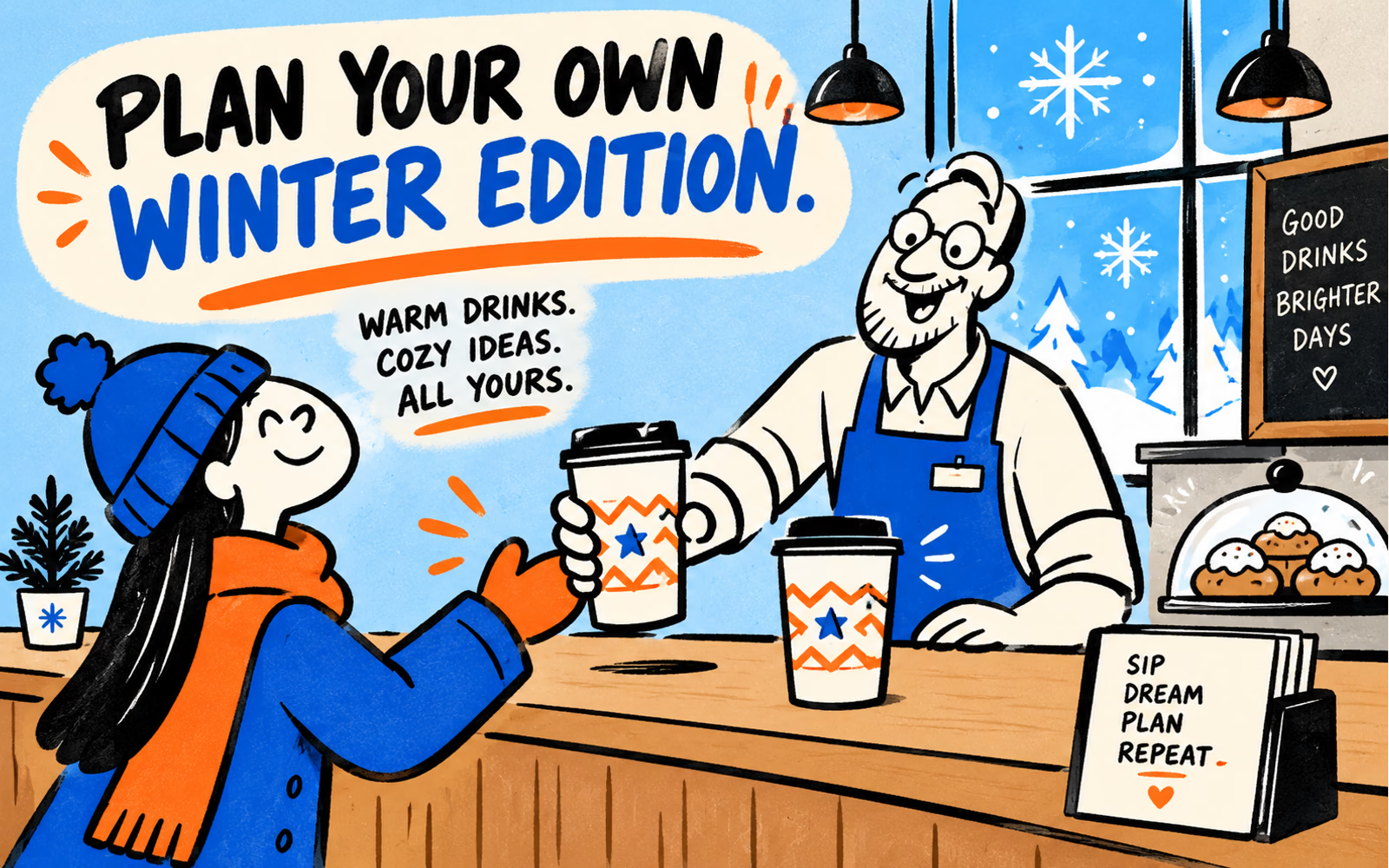
One possible independent-café concept uses a stable printed cup with temporary sleeve artwork. Another prints the seasonal treatment directly on the cup. These are choices to compare against the actual service, structure and quantities; the illustration is not evidence that sleeves are the right solution for every drink.
| Base record | Campaign record | Confirmation needed |
|---|---|---|
| Everyday identity | Original seasonal message | Approved artwork for the chosen format |
| Exact cup specification | Exact sleeve version, if used | Review of the actual cup-and-sleeve pair |
| Normal stock plan | Campaign start and stop points | Storage and counter handoff plan |
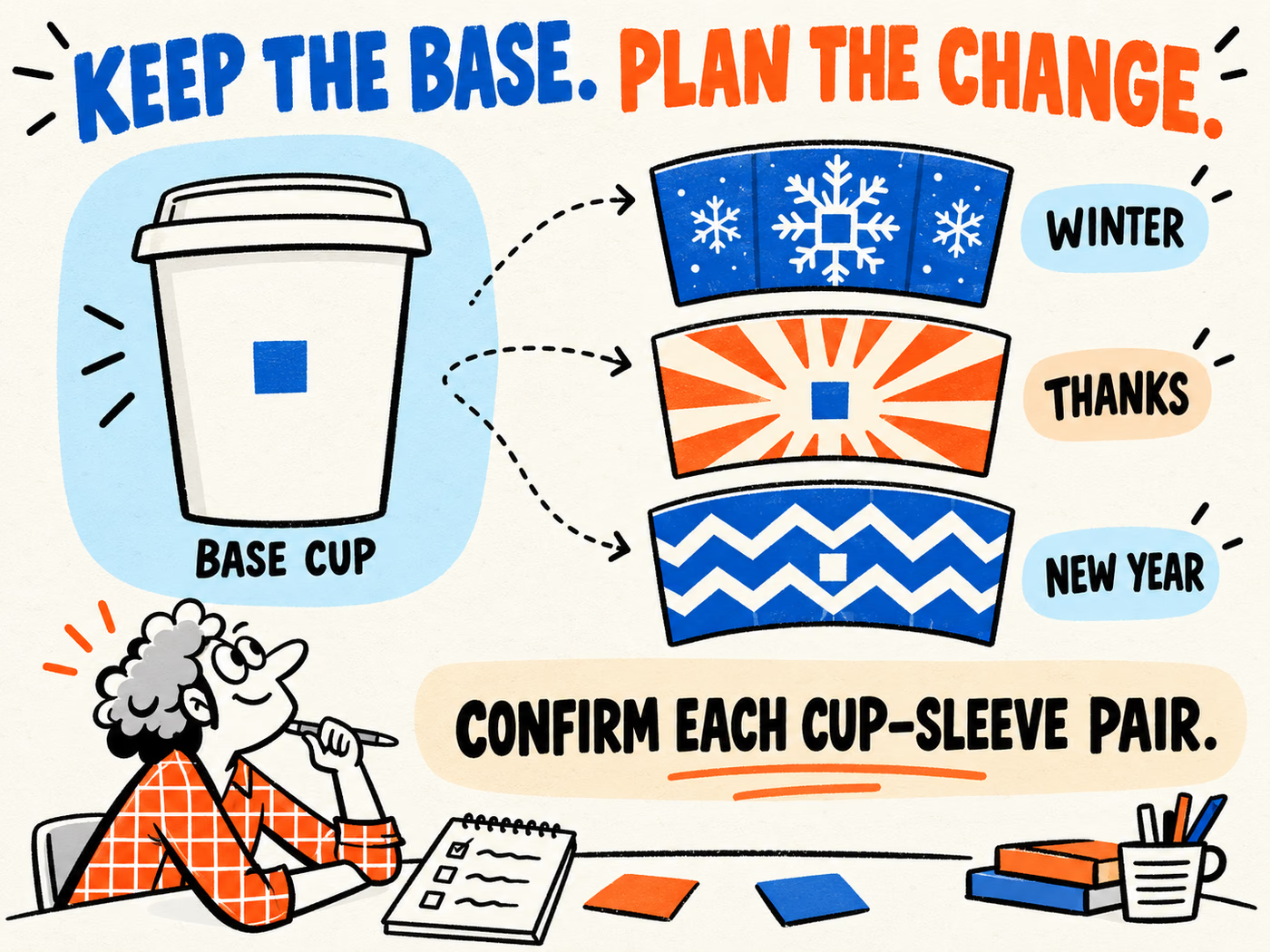
The infographic shows one conceptual base cup beside Winter, Thanks and New Year sleeve ideas. They represent separate campaign versions, not three layers to place on one cup. The sequence is an original planning exercise and does not reproduce the 2024 Starbucks collection.
Confirm capacity and exact lid pairing separately from the decoration. A sleeve’s physical relationship to a cup also needs confirmation for the specific pair. Neither the capacity label nor a matching color establishes fit.
Build an original seasonal cup concept
Choose a message that belongs to your café. A neighborhood shop might organize a winter campaign around warm conversation; another might use a locally meaningful geometric pattern. Write the message in plain language before deciding how many artwork versions it needs.
Use your own name, illustrations and pattern vocabulary. Studying a documented collection can help you ask better questions, but it does not require copying a recognizable logo, character or arrangement. Our bright blue and orange illustrations show an independent concept with simple shapes.
Give each version an operational purpose
For the three-sleeve exercise, define when Winter enters service, whether Thanks is reserved for a particular customer moment, and when New Year replaces the earlier version. If two versions have no distinct purpose at the counter, consider whether you need both.
Make a small review sheet that shows each version on the exact proposed template, its intended use and its owner. Check the readable café name and seasonal message at real output size. A large presentation image can make small print look more readable than it will be on a cup.
Discuss custom coffee cups and cup sleeves after the concept is tied to the physical format. The cup construction guide addresses a different decision that the seasonal artwork cannot settle.
Plan artwork and quantities before ordering
Create a quantity line for each design and format rather than one total labeled “holiday cups.” Use your own recent service records and planned campaign window to build the estimate. Document the assumptions, especially when a version is limited to a specific event or drink use.
Work backward from the date the packaging should be available at the counter. Include artwork review, specification confirmation, the supplier’s project-specific schedule, delivery and the internal stock handoff. Confirm that schedule for the actual order instead of assuming a general lead time.
| Version field | What to record | End-of-campaign question |
|---|---|---|
| Identity | Exact file and packaging format | Can this version be used later? |
| Timing | First and last intended service date | When does the counter switch? |
| Quantity | Estimate by version and use | What is the remaining stock plan? |
| Handoff | Storage location and team instructions | Which everyday pack returns? |
Keep the everyday stock and seasonal stock identifiable. Decide before launch how the team will handle remaining campaign pieces, and avoid printing a year unless it is useful to the concept. The Christmas packaging guide can help coordinate a wider gift assortment; it does not replace the drink-service plan.
Use the artwork guide to prepare separate files for the approved templates. Keep a final version list with quantities and delivery ZIP so the quote and artwork approval describe the same campaign. That record is also a useful starting point when you plan the next season.