
Stumptown Coffee Bags: Organizing a Recognizable Product Range
Compare current documented Stumptown blend bags and plan an original range with consistent identity, distinct variants and a separate quantity record for every artwork version.
Stumptown coffee bags can be studied as a documented product range rather than a collection of unrelated historical designs. The official Hair Bender, Holler Mountain and Homestead pages reviewed October 6, 2026 show a shared prominent brand treatment while bag colors and coffee identities vary. For your own range, define the fixed identity first, then document the changing content and quantities for every artwork version. Similar appearance does not establish identical construction or print specifications.
A range should feel connected without making every item hard to tell apart. The design task and the ordering task belong together: each difference that appears on a bag needs a corresponding approved reference in the production record.
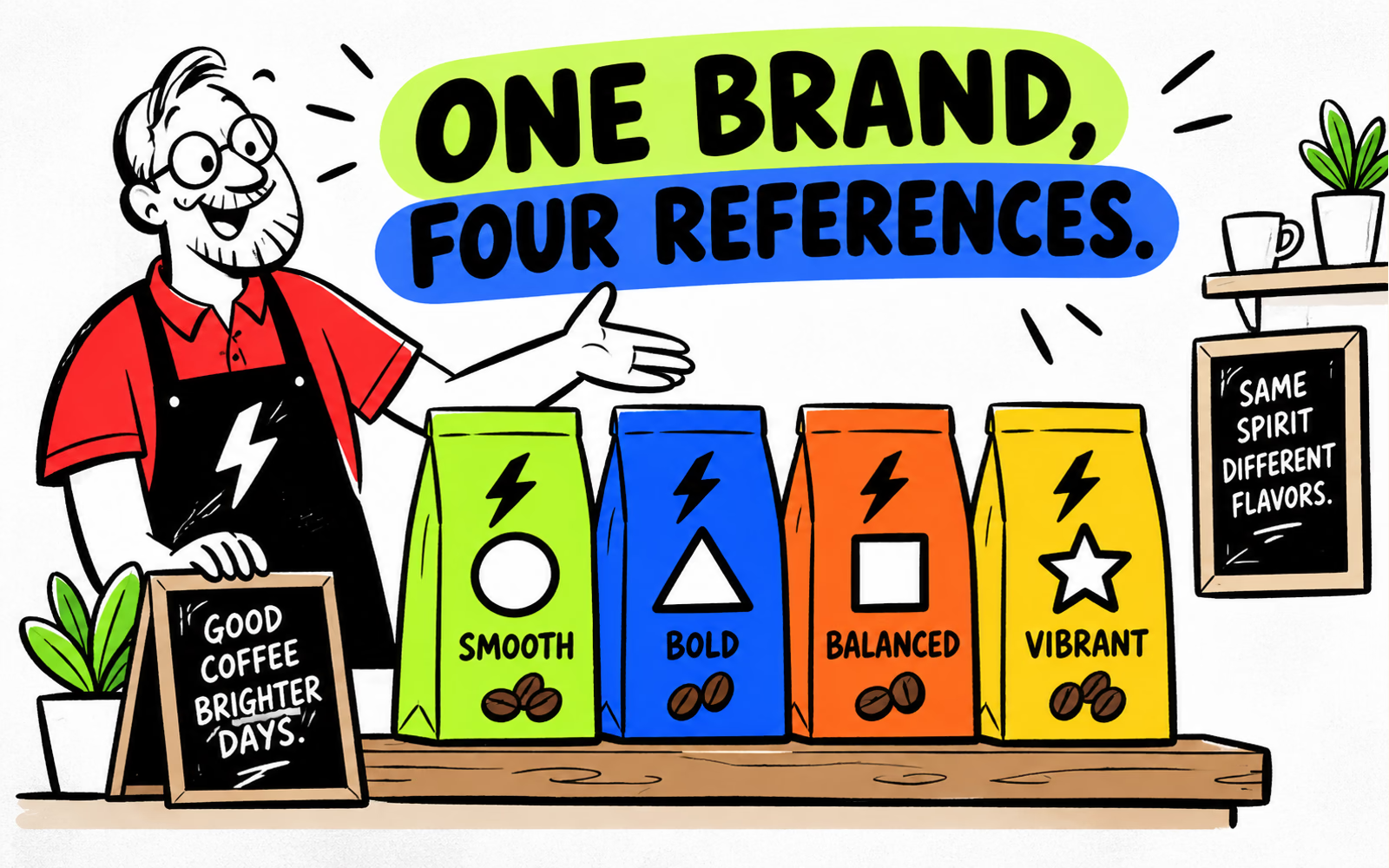
Select documented bags from one product range
We reviewed the official Hair Bender, Holler Mountain and Homestead product pages in the same session. Their currently displayed blend imagery provides a consistent comparison set. The same site also displayed the bags together in a range photograph.
This comparison excludes older redesign articles and unrelated editions. It concerns the displayed examples at the review date, not a promise that every bag size or distribution channel uses identical artwork. Record format and edition before comparing a large bag with a smaller retail pack.
| Example | Review record | Scope |
|---|---|---|
| Hair Bender | Official current product page | Displayed blend bag |
| Holler Mountain | Official current product page | Displayed blend bag |
| Homestead | Official current product page | Displayed blend bag |
| Review date | October 6, 2026 | Same-session comparison, not a historical timeline |
Our observation concerns visual relationships across the set. We have not measured manufacturing tolerances, customer recognition or sales effects. No source photograph is reproduced as a claim about BrandYourPack work.
For general concept exploration, use coffee bag design ideas. This article adds an original version matrix and ordering record. The search review is qualitative and does not include measured volume or difficulty.
Compare fixed and changing visual elements
Across the reviewed examples, the prominent Stumptown wordmark treatment provides a shared visual anchor. The displayed bag colors and individual coffee names distinguish the references. This is an observation of the official images; it does not mean every printed element stays fixed across all products.
Translate that relationship into questions for your own team. Which elements identify the maker? Which distinguish the coffee? Which fields change with approved product information or production records? Keep those questions separate from a request to copy another company’s artwork.
| Element role | Original range decision | Record needed |
|---|---|---|
| Fixed identity | Your own mark and repeatable area | Approved master artwork |
| Variant cue | Original name and supporting cue | Reference-specific artwork |
| Product information | Approved fields for each item | Content owner and version |
| Production information | Agreed changing fields | Method and responsible owner |
The four-row infographic shows a hypothetical range A through D. Origin Field and Date Field remain placeholders; they are not real origin or freshness statements. A lightning mark and simple geometric cues demonstrate a proposed original system.
Use the single-front hierarchy guide when deciding the space for each role. Here we are checking whether those relationships remain manageable across several artwork files.
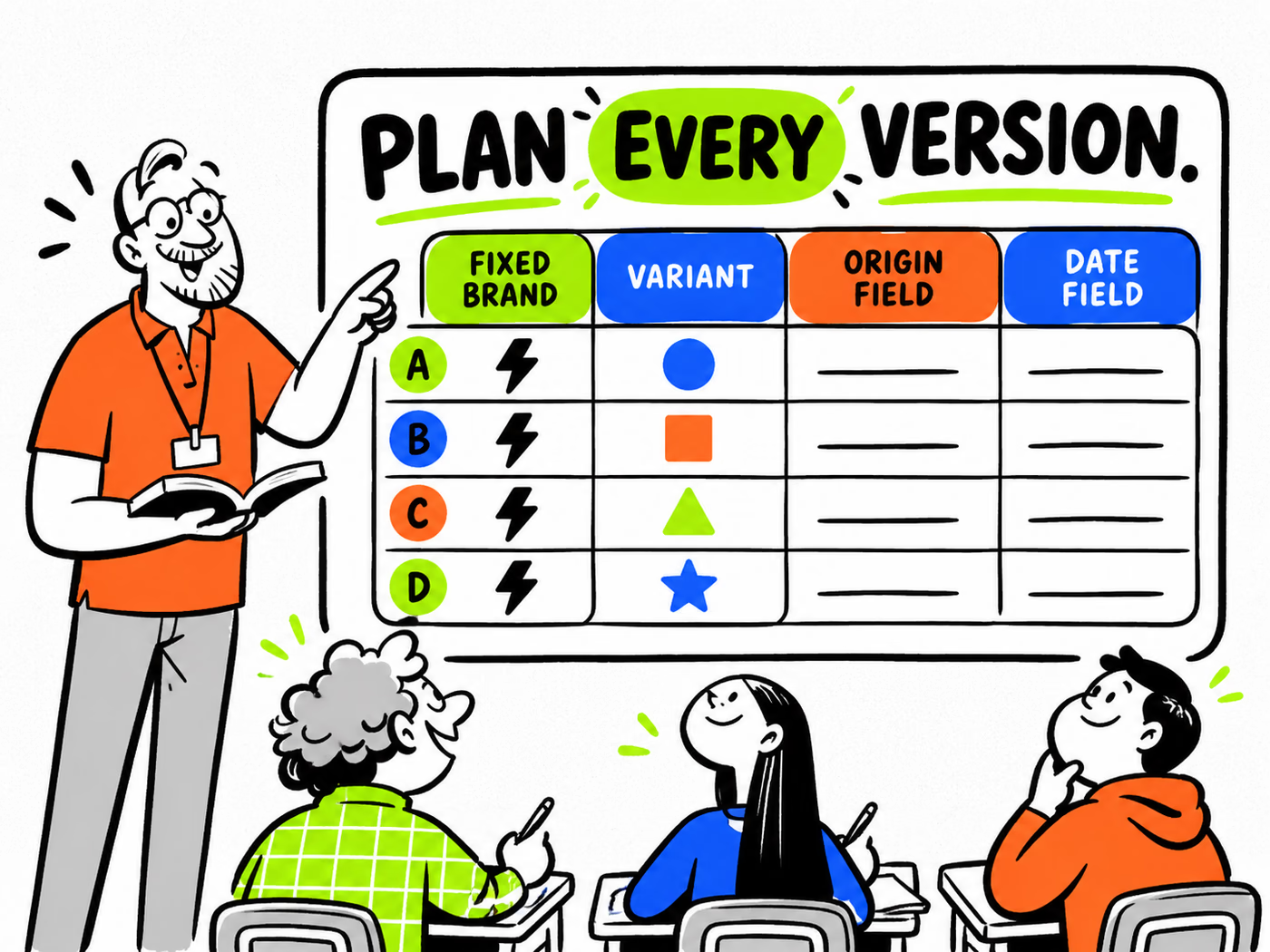
Create an original coffee variant system
Create a reference list before designing four fronts. Give every reference a unique internal identifier and approved coffee name. Then list the elements that remain fixed and the fields that change. If two variants share a color, the printed name still needs to identify the item.
Try the range together at the intended finished size. Include long names and fuller content, rather than four short placeholder labels. Ask someone using the range to identify each item and locate its information; record actual issues instead of assuming a color difference is sufficient.
| Reference | Shared identity | Variant treatment | Content status |
|---|---|---|---|
| A | Original master mark | Circle cue and approved name | Await actual product copy |
| B | Original master mark | Triangle cue and approved name | Await actual product copy |
| C | Original master mark | Square cue and approved name | Await actual product copy |
| D | Original master mark | Star cue and approved name | Await actual product copy |
Keep a master without hiding differences
A shared master can make updates easier, but each exported file still needs review. A changed name can alter line breaks; a fuller information field can displace supporting content. Review the actual exported version, not just the master that generated it.
Compare labels and printed bags according to your version workflow. Ask how a product change affects the bag, label, application step and existing stock. The answer depends on the proposed project, not on another brand’s photographed set.
Plan artwork quantities by design
An order for four references is not one undifferentiated quantity. List the requested count next to each approved file, including any size or format distinction. Keep totals and reference-level quantities visible so purchasing and artwork review use the same record.
Separate fixed printed identity from any later variable application. Confirm who applies the changing information, which material or panel it uses and how the final item is identified. Do not assume a supplier can add a field simply because it appears on a mockup.
| Reference | Artwork file | Quantity | Open confirmation |
|---|---|---|---|
| A | A — approved version | Provide requested count | Exact bag and label scope |
| B | B — approved version | Provide requested count | Exact bag and label scope |
| C | C — approved version | Provide requested count | Exact bag and label scope |
| D | D — approved version | Provide requested count | Exact bag and label scope |
Discuss coffee bags and labels with filled dimensions, closure needs and delivery ZIP. Use the pouch guide to define the physical request and the artwork guide after templates are confirmed.
Save the master relationship, individual files and quantity schedule together. For a reorder, confirm which references actually need new stock and whether their approved copy has changed. A recognizable range works best when the paperwork can distinguish its items as clearly as the artwork does.