
Easter Cookie Packaging: Original Spring Designs for Small Bakeries
Measure the finished shapes and decoration before arranging the spring assortment. Connect the pack with original botanical graphics and a clear variant record.
Easter cookie packaging starts with the actual finished cookie shapes, not an idealized outline. Measure projecting decoration and height, arrange each assortment with the proposed contact packaging, and review separation and closure on the real sample. Original botanical graphics can connect the spring collection. A gap drawn between cookies is a planning question; it does not establish protective performance, food suitability or shelf life.
An oval cookie, a long carrot shape and a broad flower do not occupy space in the same way. A useful spring collection keeps those differences visible in the packing brief, even when the graphics share one theme.
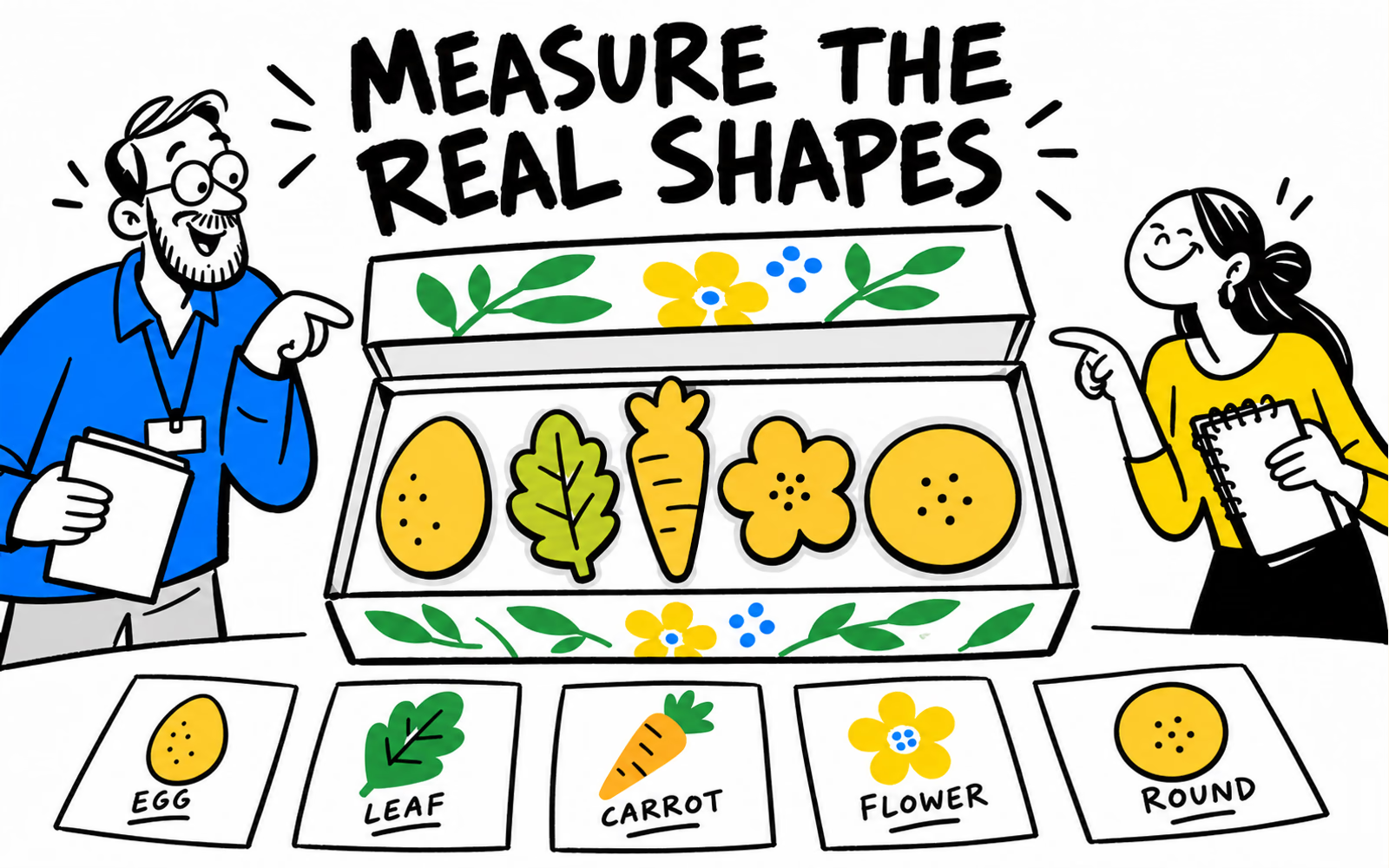
Measure the actual cookie shapes
Measure the finished products as sold, including decoration and any primary wrap. Record the widest span, length and total height with units and a clear orientation. Keep the measurements alongside a photograph or drawing of the actual product version.
A cutter’s dimensions describe the cutter. They do not describe the complete decorated cookie or the space needed around it. Include representative variations from the planned assortment so the review is not based only on the most convenient example.
Notice the awkward shapes
Our illustration uses invented oval, leaf, carrot, flower and round silhouettes. The long narrow shape and the broad flower create different arrangement questions. Treat their projecting parts as features to review rather than assuming all cookies can be packed like disks.
The cookie format guide establishes the order type. This article adds a shape-by-shape record for a spring assortment. Identify the products and quantities in each set before choosing a box from the visual theme alone.
Choose an arrangement that protects decoration
Plan how the decorated surfaces remain separated in the intended arrangement, then review that proposal with the actual products. Identify neighboring edges, contact with the lid and the path used to place and remove each cookie. Keep any proposed support or separator in the component record.
| Shape example | What to observe | Record to retain |
|---|---|---|
| Long narrow cookie | Its position and projecting ends | Actual outline and proposed neighbors |
| Broad flower shape | The widest span and decorated edges | Finished dimensions and placement |
| Oval or round cookie | Possible contact and movement | Primary pack, gaps and closure review |
| Mixed-height assortment | Clearance above each finished item | Product versions and complete sample |
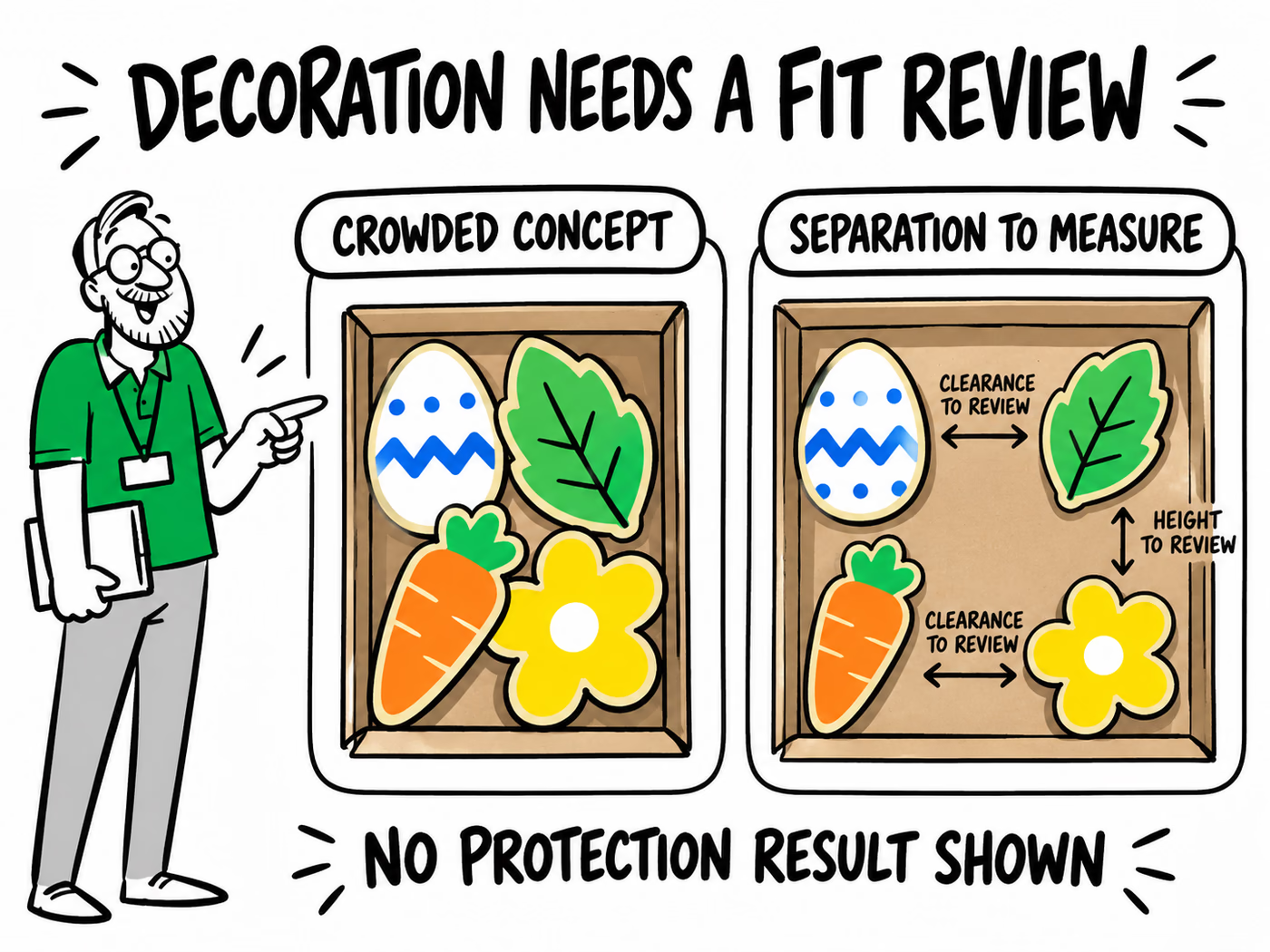
Compare crowded and separated proposals
The first diagram shows a crowded concept; the second marks spaces for clearance review. Neither provides a universal gap or a successful protection result. Measure and examine the actual arrangement instead of copying a distance from the drawing.
Confirm food-contact components for the actual product and intended conditions with the responsible suppliers. A decorative paper or spring label does not establish that suitability. If an outer delivery pack is needed, use the complete-arrangement method and review that journey separately from the gift presentation.
Build an original spring graphic system
Choose a few original botanical shapes, a readable type treatment and a compact palette. Our fictional collection repeats simple leaf and flower graphics in bright green, blue and yellow. The theme can connect labels and carton panels without requiring a special novelty-shaped box.
Keep the product identifier visible within the design. Use copy supplied and reviewed by the responsible food business for actual ingredients, handling or other product information. A pretty spring headline should not replace the information belonging to the food.
Let the motif scale with the component
A small label may need one bold leaf and clear words. A larger panel can carry a repeating pattern. Review both at their intended printed sizes and on the assembled pack; a design that is readable on a large screen can become crowded near folds or closures.
The seasonal collection guide helps coordinate component roles. The Halloween guide adds another original seasonal system while keeping contact packaging separate from decoration. Develop your own artwork rather than borrowing recognizable commercial characters.
Prepare the seasonal packaging specification
List each assortment, actual product version, proposed construction and artwork reference. Include quantities by set and the planned campaign dates. If a taller decoration or wider cookie joins the range, identify which arrangement must be reviewed again.
Use the consumption calculator with expected orders, usage per order and actual stock. Keep lead time, purchase quantities and any extra cover as project inputs requiring confirmation. A seasonal plan does not guarantee a manufacturing slot or a delivery date.
Bring fit and graphics into one brief
Explore folding cartons and labels with the confirmed specification. State intended use, packed dimensions, material questions, print versions, quantities and delivery ZIP. Attach the actual assortment record rather than only a decorative reference.
Follow the artwork guide for the approved structure. Review final copy, placement and the physical sample together. Keep the outcome limited to what was actually examined; the illustration supplies no safety, shelf-life or damage-free-delivery claim.