
Packaging Mockup vs. Prototype: What Each Review Can Actually Confirm
Match each approval to the evidence available. A screen preview, a physical sample, and a functional test answer different packaging questions.
The packaging mockup vs. prototype decision starts with the question you need to answer. A digital mockup can communicate artwork and presentation; a physical sample can support hands-on checks within its stated scope. A functional test requires a defined method and results. The names alone do not establish production materials, print accuracy, fit, or shipping performance. Ask what each piece represents before approving it.
“Looks good” is a useful design response. It becomes a risky production instruction when nobody has agreed what was actually reviewed.
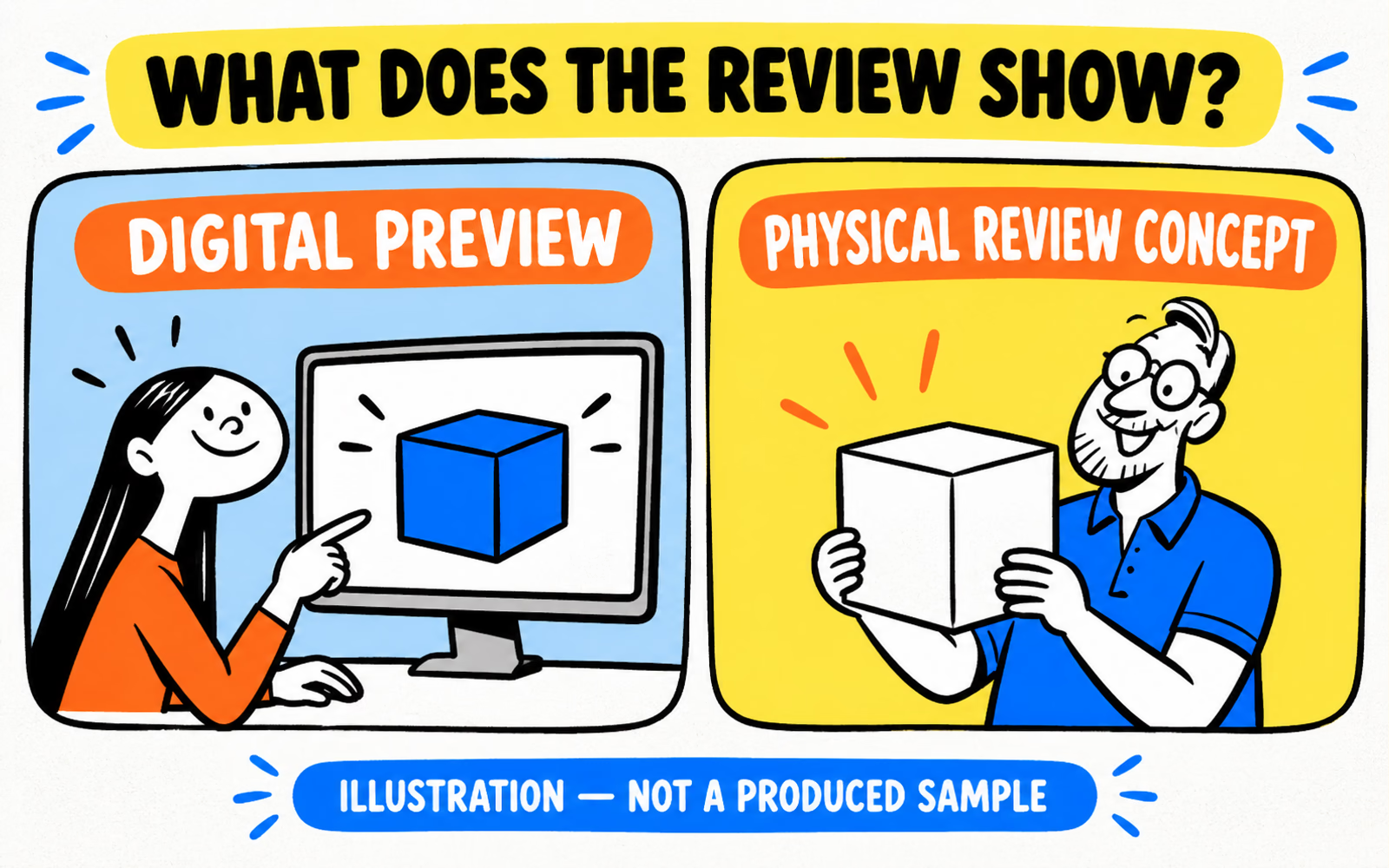
Separate a digital mockup from a physical sample
Name the evidence in the review request. Identify whether you are looking at a rendered image, a flat layout proof, a blank construction sample, a printed sample, or a piece made using an agreed production process. Suppliers may use “mockup” and “prototype” differently, so define the object rather than relying on the label.
Write one honest description
For example: “Digital presentation showing the current artwork on a conceptual box” describes an image. “Blank sample supplied for an initial packed-fit review” describes a physical piece with a limited purpose. Neither description quietly approves the final printed order.
Keep the file or sample reference visible. Record its date, dimensions, version, and any differences from the proposed production specification. Follow the artwork guide once the actual format and template are confirmed.
The opening illustration contains two drawings. Its physical-review panel illustrates a task; it does not show something BrandYourPack has manufactured for this article.
List what each review can check
Start with the decision, then ask what evidence would make that decision reasonable. A large screen image may reveal a spelling mistake while leaving the closure behavior entirely unanswered.
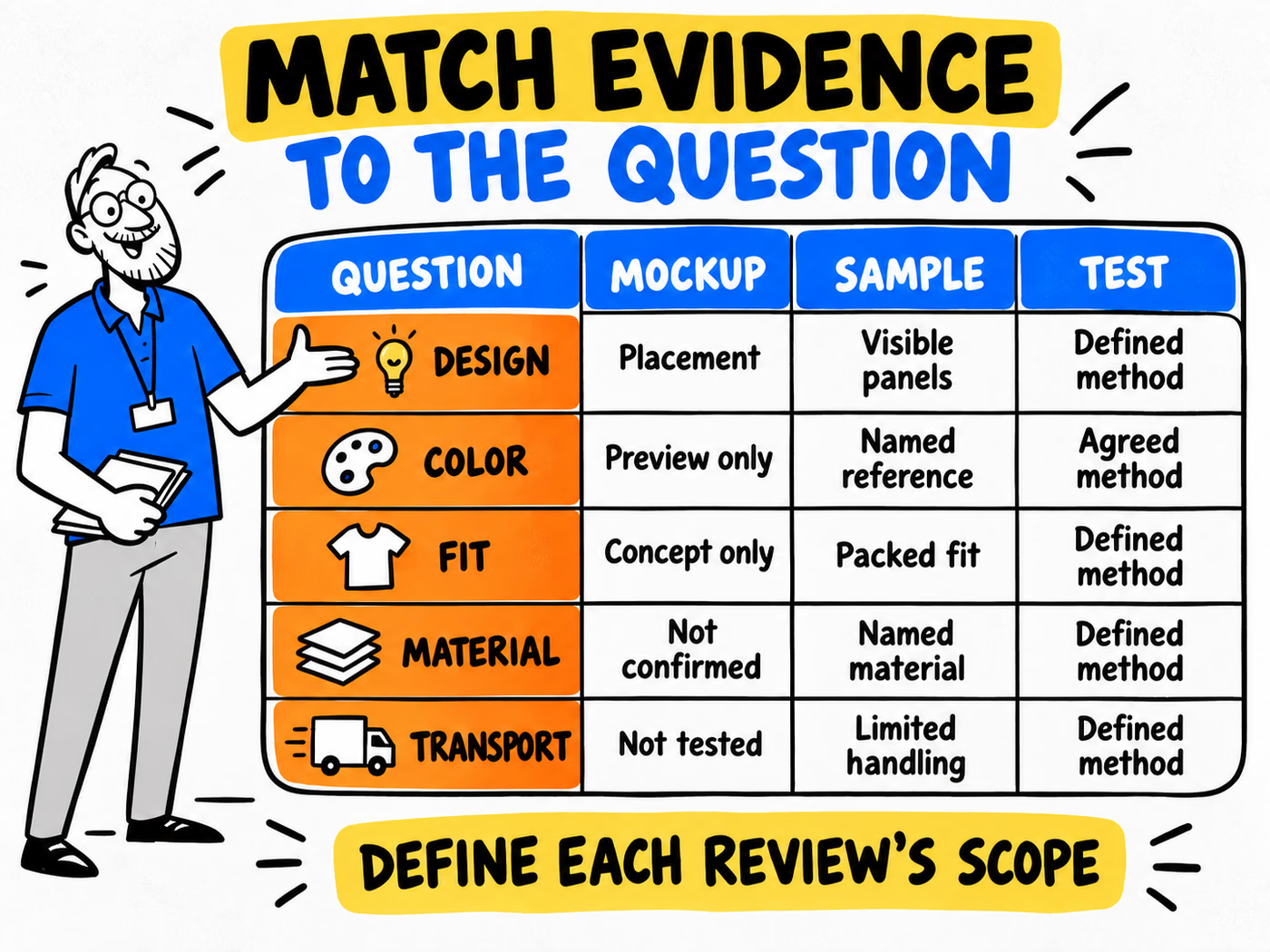
| Question | Useful review | Scope to establish |
|---|---|---|
| Design placement | Current layout or mockup | Correct panels, artwork version, and opening view |
| Color appearance | Agreed proof or physical reference | Process, surface, finish, and viewing conditions |
| Packed fit | Representative assembled sample | Actual contents, support, dimensions, and closure |
| Material | Identified sample and specification | Which material and construction it represents |
| Transport | Defined performance review or test | Method, arrangement, conditions, and recorded results |
A sample is not a universal pass
A piece that holds the product during a desk review does not, by that observation alone, establish a shipping result. Likewise, a generic material sample does not prove how your artwork will print on the finished construction.
The infographic describes review scope, not passed results. “Packed fit” names a question for a suitable sample; “defined method” means the test must have an agreed method and record. None of its cells turns a sample into five automatic approvals.
Record unresolved material and fit questions
Keep an open-issues list beside the attractive preview. For each issue, write the affected component, the question, the evidence still needed, and the person responsible for resolving it. An unanswered question is easier to manage when it has a clear next step.
Try a concrete packing example
A fictional gift set has a retail carton, a small accessory, and a message card. The mockup shows all three neatly arranged. Before requesting a mailer box, assemble the real proposed arrangement and record its dimensions and support needs with the measurement guide.
Ask whether the available sample includes the intended insert, material, and closure. If it differs, document that difference. A substitute can still inform a limited review, but the approval should identify what remains open.
For the retail layer, compare product boxes and folding cartons by the actual brief. Product-family names do not supply the missing specification.
Approve the right evidence for the next production step
Write approval as a decision with a boundary: what was reviewed, what is accepted, what is excluded, and which version moves forward. “Layout approved for this file; material and fit review still open” is much clearer than “approved” beneath a render.
- Identify the decision needed next.
- Name the exact file, piece, or test record reviewed.
- Compare it with the agreed specification.
- List accepted elements and unresolved differences.
- Confirm the next action and retain the approval record.
Discuss available samples, proof scope, costs, and timing for your project rather than assuming a particular service is included. Use the color-reference worksheet when coordinating several components.
For later orders, keep the record with the reorder checklist. Revisit approval when the construction, material, process, artwork, or packed contents change. This guide offers a review method, not fabricated sample results.