
Starbucks Cup Sizes: US Ounces, Milliliters, and Hot vs. Iced
A US size chart with rounded milliliter conversions, the hot-versus-iced Venti difference, and practical checks for your own café’s cups.
US Starbucks menu examples list Short at 8 fluid ounces, Tall at 12, and Grande at 16. Venti differs: 20 fl oz for the hot latte example and 24 fl oz for Cold Brew. Cold Brew also lists Trenta at 30 fl oz. Not every drink offers every size. These are menu capacities, not measurements of cup height, rim diameter, or lid fit.
If you are comparing cup ranges for your own café, Starbucks’ familiar names provide a useful reference. The important step is separating the menu size from the physical cup specification. A size name helps customers order; it does not tell a packaging supplier which lid will fit.
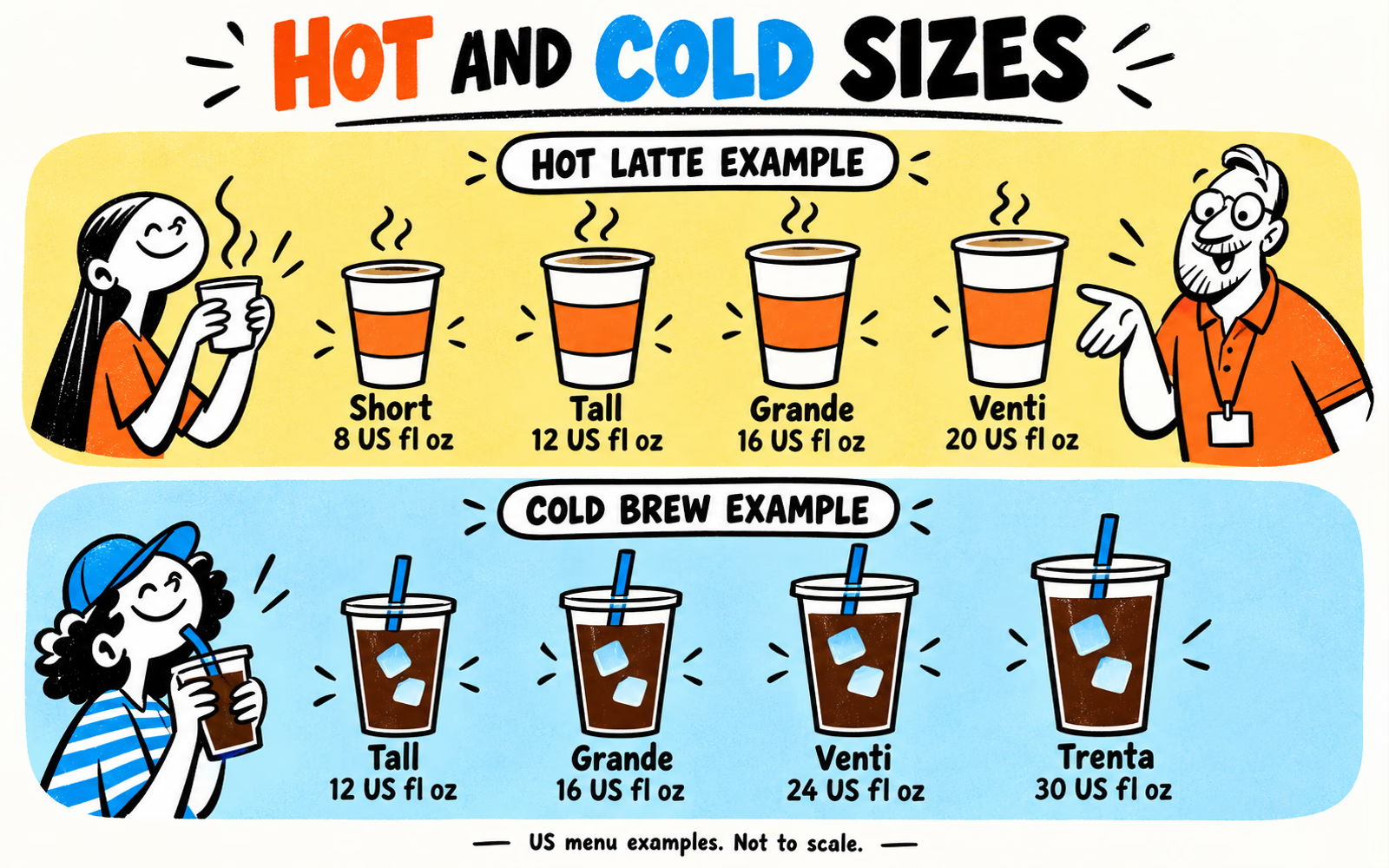
US Starbucks sizes at a glance
The chart uses two official US menu examples: Caffè Latte for hot sizes and Cold Brew for cold sizes. It does not imply that every Starbucks beverage is available in all of these formats.
| Size | Hot latte example | Cold Brew example | Approximate milliliters |
|---|---|---|---|
| Short | 8 US fl oz | Not listed | 237 mL |
| Tall | 12 US fl oz | 12 US fl oz | 355 mL |
| Grande | 16 US fl oz | 16 US fl oz | 473 mL |
| Venti | 20 US fl oz | 24 US fl oz | 591 mL hot / 710 mL cold |
| Trenta | Not listed | 30 US fl oz | 887 mL |
Milliliters are calculated using approximately 29.57353 mL per US fluid ounce, from NIST’s conversion factors, then rounded to the nearest whole milliliter. They are conversions of the menu labels, not measurements of a physical cup.
Why you may see a different Trenta number
This guide follows the 30 fl oz label in the cited US Cold Brew menu rather than substituting a capacity from another market, an older reference, or a measured container. If you are ordering a drink, check its current menu options and the selected café’s availability.
Fluid ounces are a volume unit
Here, “fl oz” means US fluid ounces. An ounce used for a coffee bag’s net weight is a different kind of measurement. Keep the unit explicit when comparing beverages, packaging specifications, or metric conversions.
Hot and iced formats are not interchangeable
The clearest difference in the chart is Venti. The two cited examples use different capacities for hot and cold service. Treating Venti as one universal volume would obscure that distinction.
For an independent café, an iced drink and a hot drink may also have different working requirements. Ice, foam, toppings, the intended fill level, and the drinking opening all belong in the planning conversation.
Compare like with like
When comparing menu examples, keep the drink and service type beside the size. “16 US fl oz, cold service” is more useful than “medium.” When preparing your own brief, add the requested cup construction and exact lid requirements.
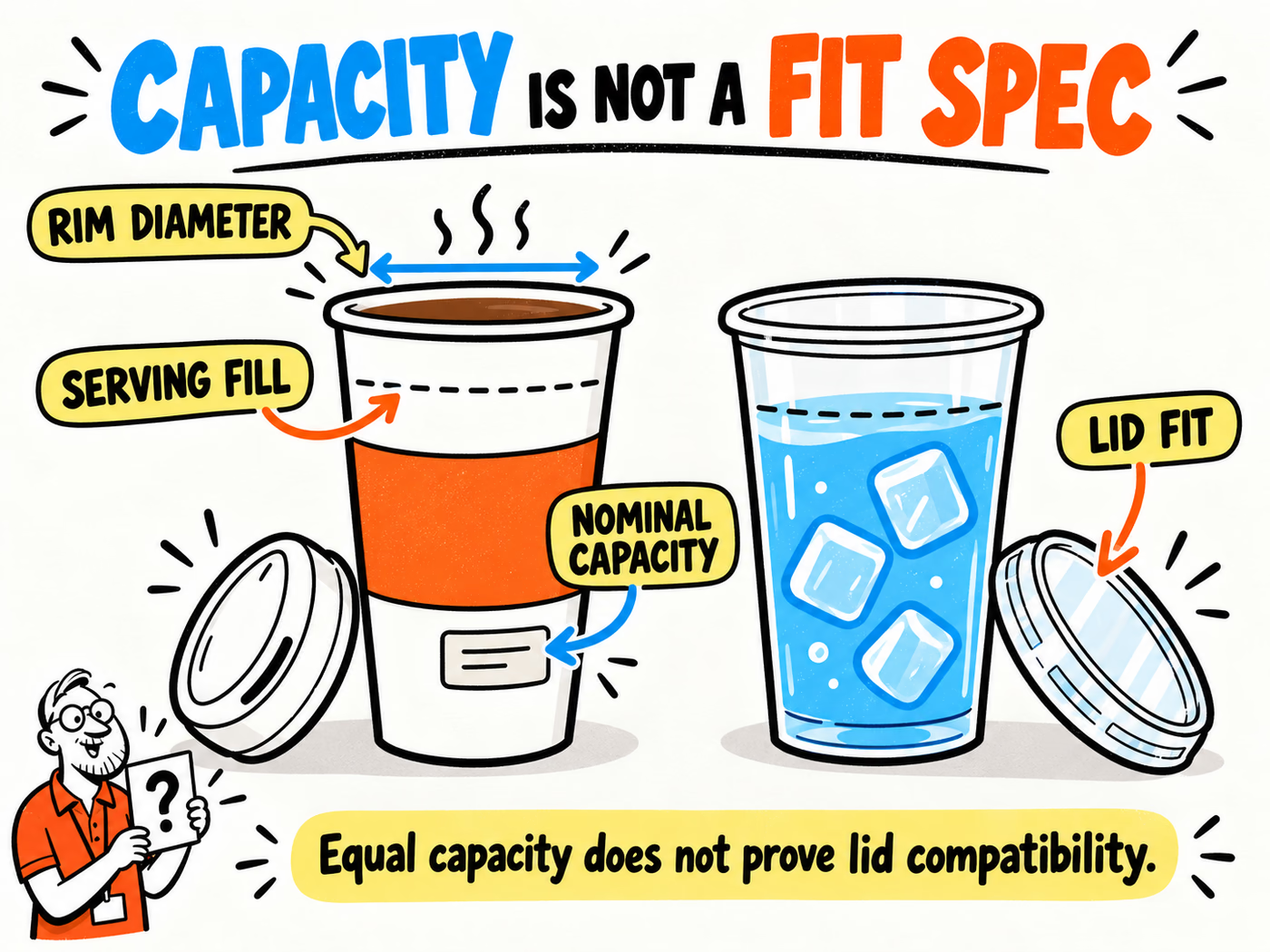
Do not infer that cups with equivalent capacities share rim dimensions or that a hot-service lid can be used on a cold cup. The physical cup and closure need their own matching specifications.
What cup capacity does not tell you
A capacity label answers one question about volume. It leaves several practical questions open.
| Detail | What to record or confirm |
|---|---|
| Nominal capacity | The stated volume and whether it is a menu label or a supplier specification |
| Serving fill | Your actual recipe, ice, foam, toppings, and intended working space |
| Rim and cup geometry | Actual dimensions of the proposed cup, supplied by the manufacturer |
| Lid connection | The exact matching cup-and-lid specification and a sample fit check |
| Service conditions | Hot or cold use, handling, sleeve needs, and any other requirements to review |
Two cups can carry the same nominal ounce label and still differ in shape, construction, and rim connection. A photograph of a branded cup cannot establish those measurements. The diagram below separates the questions without adding invented dimensions.
Use our cup sizes and lid compatibility guide to turn these questions into a working specification. If you are comparing wall constructions, see single-wall versus double-wall cups.
Choose a cup range for your own café
You do not need to copy a national chain’s names or offer its entire size range. Start with the drinks you serve and the portions your customers actually order.
- List the complete menu. Separate hot, iced, and topped drinks.
- Record the served portion. Include the working space needed for ice, foam, or additions.
- Compare requested capacities. Look for a manageable range that fits the menu rather than adding a size for every recipe.
- Confirm the complete system. Check the exact proposed cups, lids, and any sleeves together.
- Plan stock by format and design. Estimate demand separately for each cup and matching component.
For example, a fictional café may find that several drinks can share a requested capacity while still needing different hot and cold constructions. That is a planning hypothesis to evaluate with the actual recipes and proposed components, not a recommendation of a universal size.
Explore custom paper cups, coffee cups, and plastic cups according to the intended use. Their product pages are entry points for a quote; they do not confirm a particular Starbucks specification or a lid match.
A familiar size reference.
A cup range of your own.
Planning your own café packaging? Share your drink use, requested capacities, exact lid needs, quantities by design, and delivery ZIP for a custom quote.
Sources & conversion method
- Starbucks US: Caffè Latte — Short, Tall, Grande, and hot Venti menu labels.
- Starbucks US: Cold Brew — Tall, Grande, cold Venti, and Trenta menu labels.
- NIST: Appendix B.8 conversion factors — US fluid ounces to milliliters.
Reviewed October 6, 2026. Menu availability depends on the beverage and café. Converted milliliters are rounded calculations. BrandYourPack is independent of Starbucks; the original unbranded illustrations do not depict official cups, actual supplier dimensions, or product tests.