A structural insert locates items; loose fill supports an arrangement using a different assembly method. Compare them on the actual contents, edition changes and complete shipment.
Subscription box inserts vs. crinkle paper should be compared on the same products and intended journey. A shaped support proposes defined item positions; loose fill uses material and a packing method around the items. Review contact, movement, assembly, and edition changes for each complete arrangement. A printed insert card is a message format, not a structural support.
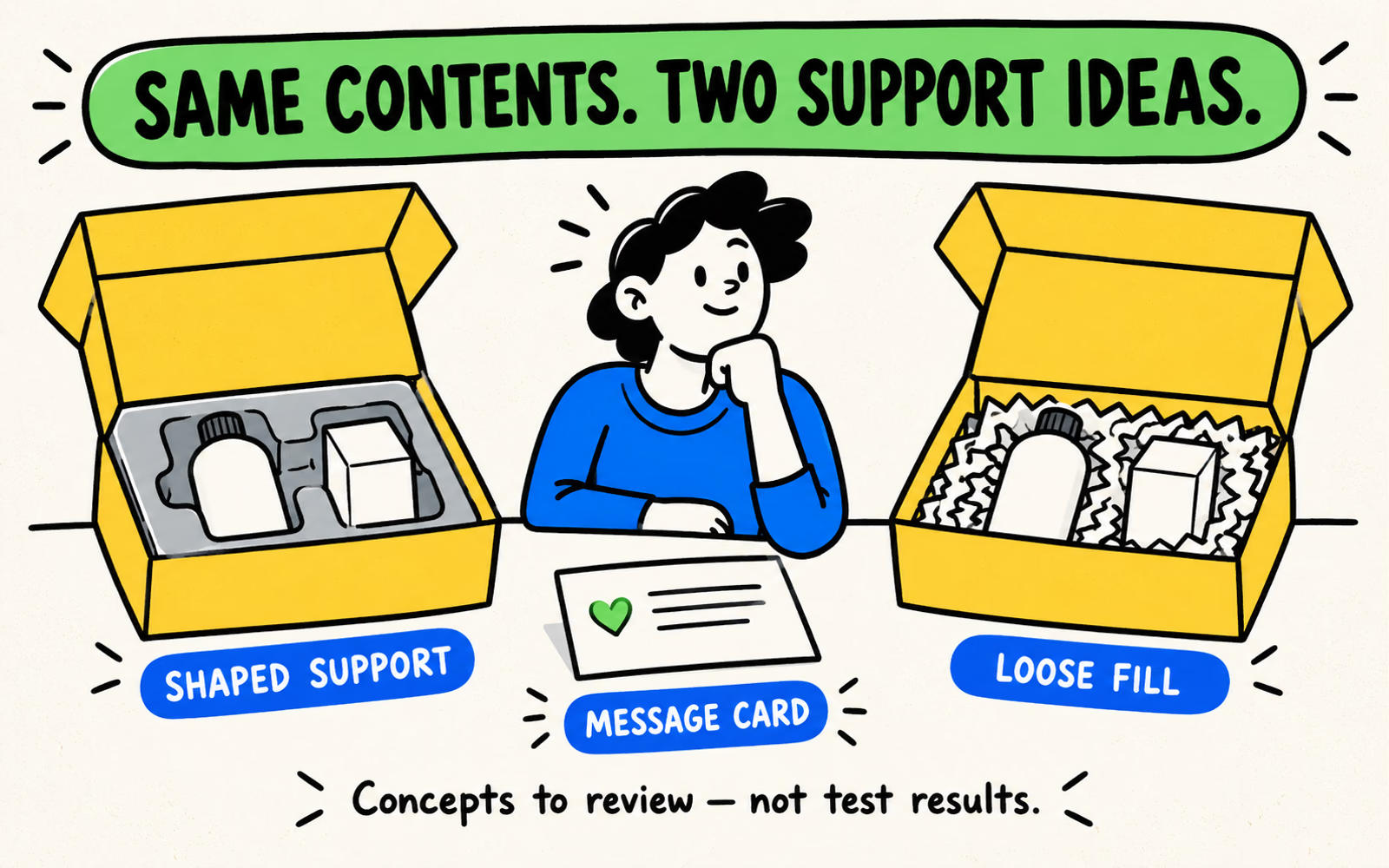
The illustrated comparison adds a practical trial worksheet to the existing method guide. It shows the questions to investigate, rather than a winning material or a completed protection test.
Define the products and the support required
List the actual item references and primary packs, including parts that must remain separated, labels that should remain readable, and surfaces that should avoid rubbing. State how the order will be handled and received. A generic “gift kit” description leaves too much unanswered.
Describe the job of each holding part
In a fictional bottle-and-carton set, ask how the bottle base is located, whether the two items can contact one another, and how each is removed. A support can be reviewed for those specific jobs without claiming it solves every hazard.
Use the mailer-box measurement guide for the usable envelope. Space consumed by a holding part belongs in the packed layout, not outside the size calculation.
Compare a shaped support with loose fill
Prepare two concepts with equivalent box and contents. For the shaped-support option, describe proposed locations, contact areas, and clearance. For loose fill, identify the actual material and proposed placement method. “Crinkle paper” by itself does not define the quantity or completed arrangement.
| Review point | Shaped support | Loose fill |
|---|---|---|
| Item location | Which contact points locate each item? | How does the packing method establish position? |
| Remaining spaces | What can move within each opening? | Where are gaps left after packing? |
| Removal | How is the item accessed without forcing it? | What must the customer move first? |
| Repeatability | Which component and layout version is used? | How is the method and usage recorded? |
Put a printed message card outside this structural comparison. Use packaging insert-card ideas for the message. Its presence should not be mistaken for a protective part.
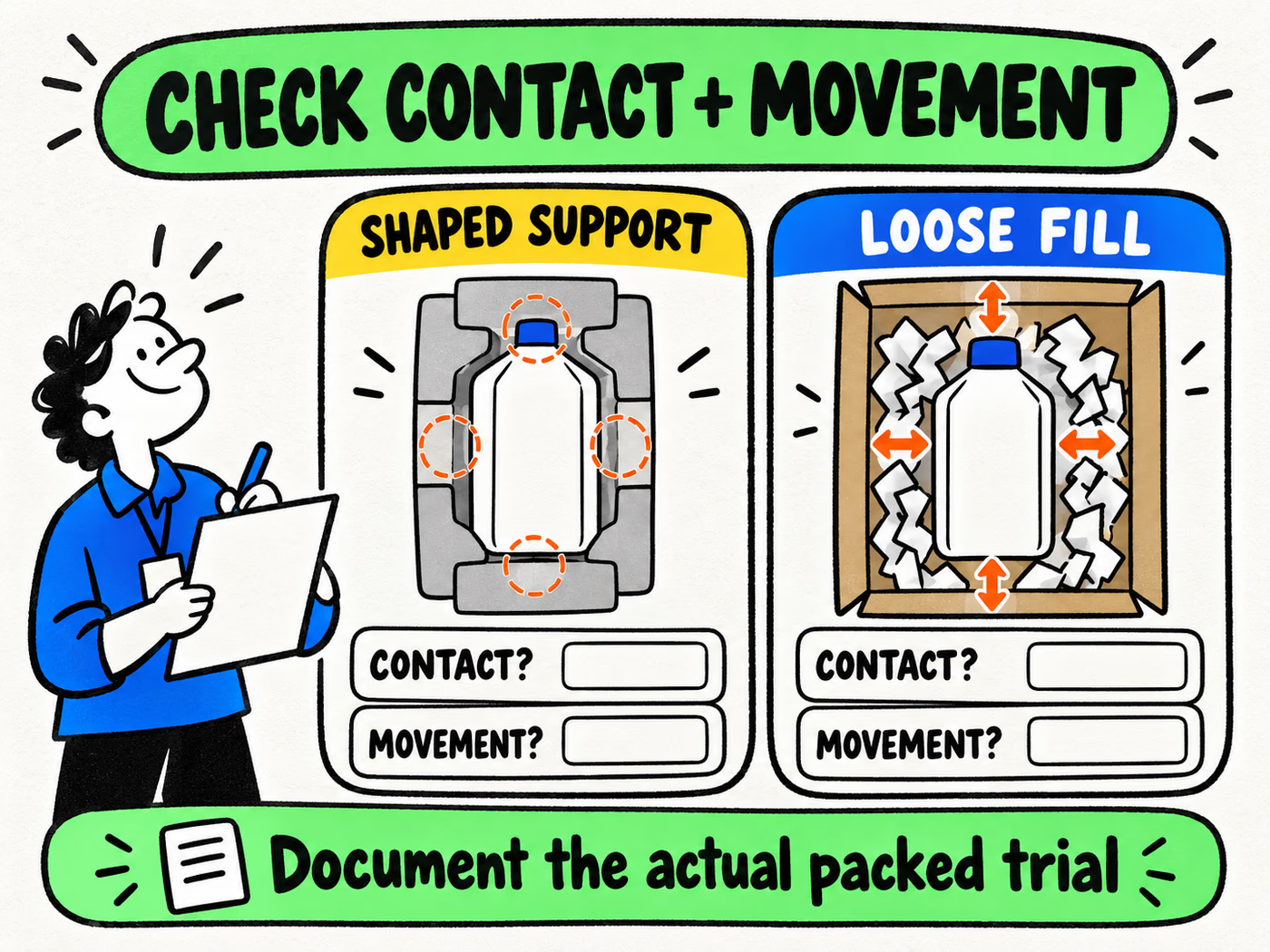
The diagrams indicate possible contact and movement questions. They supply no force values, transport results, or protection score. BrandYourPack’s existing guide does not establish a confirmed structural-support or loose-fill offer.
Check movement, assembly, and edition changes
Assemble each proposed configuration with the actual items. Record where a part touches, where a gap remains, and what changes when the arrangement is handled under your defined review conditions. Keep observations tied to the reference codes and procedure used.
Observe the packing work
Note preparation steps, piece count, placement order, closing, and the final identity check. Observe your own packing time for more than one repeat so a single unfamiliar attempt is not treated as a universal rate. Record any correction or repacking step separately.
Then change an item in the example: a wider bottle or a smaller carton. Check both arrangements again. A shaped opening may need redesign, while loose fill may need another material quantity or placement method. Neither response should be assumed before the revised pack is reviewed.
Use the edition-range worksheet to record the change. Keep assembly observations separate from any formal evidence needed for the intended transport.
Request feasible structures and test the packed result
Send the contents list and layout with the outer-box request. Identify any support or fill as a proposed component requiring separate feasibility and sourcing confirmation. Ask for material, dimensions, quantity, preparation, and sample scope rather than ordering an unspecified “protective insert.”
For the trial record, include box and item references, holding-component code, arrangement photographs, packed weight, conditions, observations, and unresolved questions. The sample-review checklist helps define that record; it is not a completed test certificate.
Compare mailer boxes and shipping boxes as outer-pack references. Evaluate their role with the proposed holding system and actual contents.
Approve the arrangement you have evidence for, and state its limits. If an edition changes beyond that scope, reopen the review instead of carrying a previous conclusion forward automatically.
References & planning resources
BrandYourPack’s original planning examples and blank worksheets support project review; they are not completed trials or confirmed supplier terms.
Compare the holding job, not the opening image
| Decision | Structural insert | Loose fill |
|---|---|---|
| Item positioning | Defined locations in a proposed structure | Position depends on the selected fill and packing method |
| Edition changes | May require revised cavities or layout | May require changed quantity or procedure |
| Assembly | Insert preparation and item placement | Fill preparation and controlled packing |
| Evidence | Exact insert/box/item arrangement | Exact fill/box/item arrangement |
Neither approach establishes shipping protection simply by looking complete. The actual system needs review for its intended contents and journey.
Keep the components correctly named
A printed insert card is a message card, not a holding structure. A structural divider, die-cut insert or loose fill requires a separate material and sizing request. BrandYourPack has not added a confirmed structural-insert or loose-fill offer through this guide.
The existing insert cards remain an edition-information format. Select the outer box separately from any proposed holding solution.
Review assembly across changing editions
Record how many pieces are prepared, the placement sequence and how staff recognize the correct configuration. Observe your own assembly time for the large and small editions. An insert optimized for one month may require another configuration when item dimensions change.
Compare material quantities and separately quoted tooling/setup, storage and handling using actual supplier proposals.
Document the exact proposed arrangement
- Box, item and holding-component sample codes.
- Packed arrangement, weight and orientation.
- Method and conditions used for evaluation.
- Observed movement, opening and assembly issues.
- Limits of the trial and questions requiring further evidence.
Use the sample checklist and the edition-range matrix.
This is a planning method, not a report of completed sample tests. Keep approval tied to the exact proposed construction, artwork and intended use.
Questions about this decision
Do structural inserts always protect better?
No universal result is established. Evaluate the exact structure with the actual items and intended shipment.
Can tissue paper replace a structural insert?
Presentation tissue and a holding structure have different roles. Any proposed alternative needs its own complete arrangement review.
Can I order a generic protective insert from this page?
A dedicated protective-insert offer is not confirmed here. Use the guide to prepare a reference-specific sourcing request.