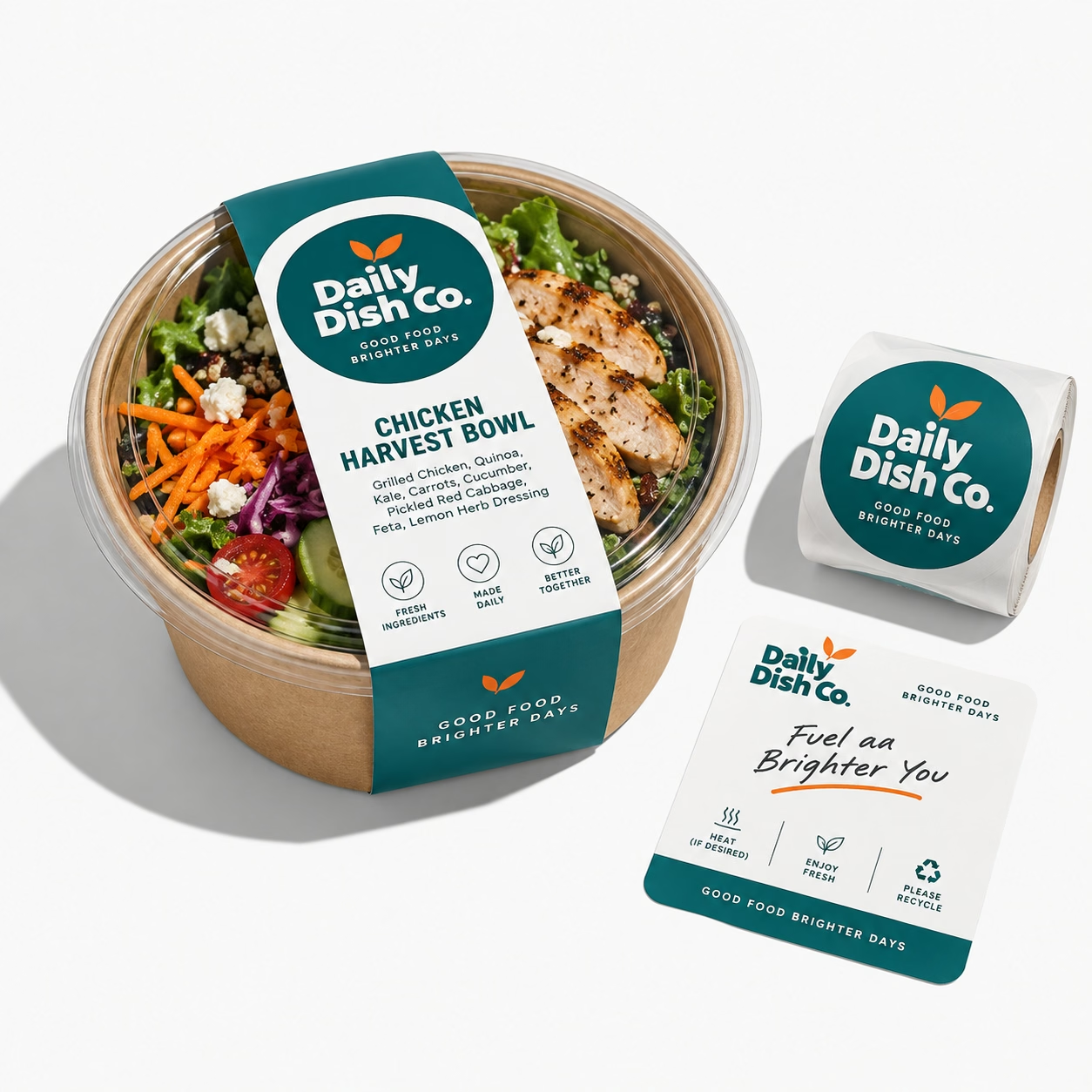
Test the proposed label on the exact meal prep container through your real application and handoff sequence. Record adhesion, appearance and readability separately.
Identify the surface and sample construction
Record the container material or supplier code, finish, curved area and proposed label reference. Identify the label face material, adhesive and print version through supplier information. A photograph or the word plastic does not uniquely identify the surface.
| Record | Why it matters |
|---|---|
| Container reference and lid | Keeps the tested substrate identifiable |
| Label construction and version | Distinguishes material and adhesive changes |
| Placement and size | Defines curved or flat contact area |
| Surface condition | Records moisture, residue and preparation |
| Application sequence | Distinguishes before-chill and after-chill workflows |
Use the actual packing sequence
Follow the proposed supplier application instructions. Record surface condition, application environment and the interval before handling or chilling. Reproduce the intended storage and handoff conditions with the agreed sample. Do not substitute a clean room-temperature trial for a damp-container workflow.
Avery explains that moisture and surface preparation affect its label application in its application guide. Use that principle to ask questions; its product instructions and timings are not specifications for a BrandYourPack label.
Score distinct observations rather than one pass label
- Edges: lifting, peeling or detached areas.
- Face: bubbles, wrinkles or visible damage.
- Print: readability and changes after handling.
- Placement: interference with lid or other information.
- Removal: only if a defined removal requirement is part of the brief.
Record the elapsed time, conditions and number of samples for each observation. A limited trial does not certify universal freezer, moisture or reheating performance.
Turn the result into a reference-specific decision
Keep photos, sample codes, observations and the reviewer associated with the proposed order. Change one variable at a time when comparing alternatives. Ask for construction-specific documentation before making a performance claim.
Use the surface checklist for the brief and the sample record for a reusable observation format.
BrandYourPack planning worksheet. Sample checks described here are steps for your project, not published test results. Confirm material, dimensions, print, quantities and intended use for the proposed reference before approval.
Questions about this decision
Does a film label automatically work on a chilled container?
No. The adhesive, substrate, application conditions and full construction must also be reviewed.
Can I apply a standard label directly to condensation?
Do not assume it will bond. Describe the damp-surface workflow and request a construction and application method intended for it.
Does a successful trial prove every container will work?
No. Retain the exact reference and conditions tested; repeat the review when material, size or application changes.