
Corporate Gift Packaging: Build a System for Different Recipient Groups
Coordinate a gift collection with shared brand elements and group-specific messages. Keep contents, quantities, artwork, and delivery scope distinct by version.
Corporate gift box packaging needs a version plan as well as a coordinated appearance. Define the contents for each recipient group, choose shared brand elements, and assign the correct message card and quantity to each version. Review packing and delivery requirements separately. A personalized message concept does not establish individual variable printing, assembly, storage, or multi-address shipping services.
A welcome gift, a client thank-you, and a team gift can belong to one collection while doing different jobs. Give each group a clear brief before turning that collection into artwork.
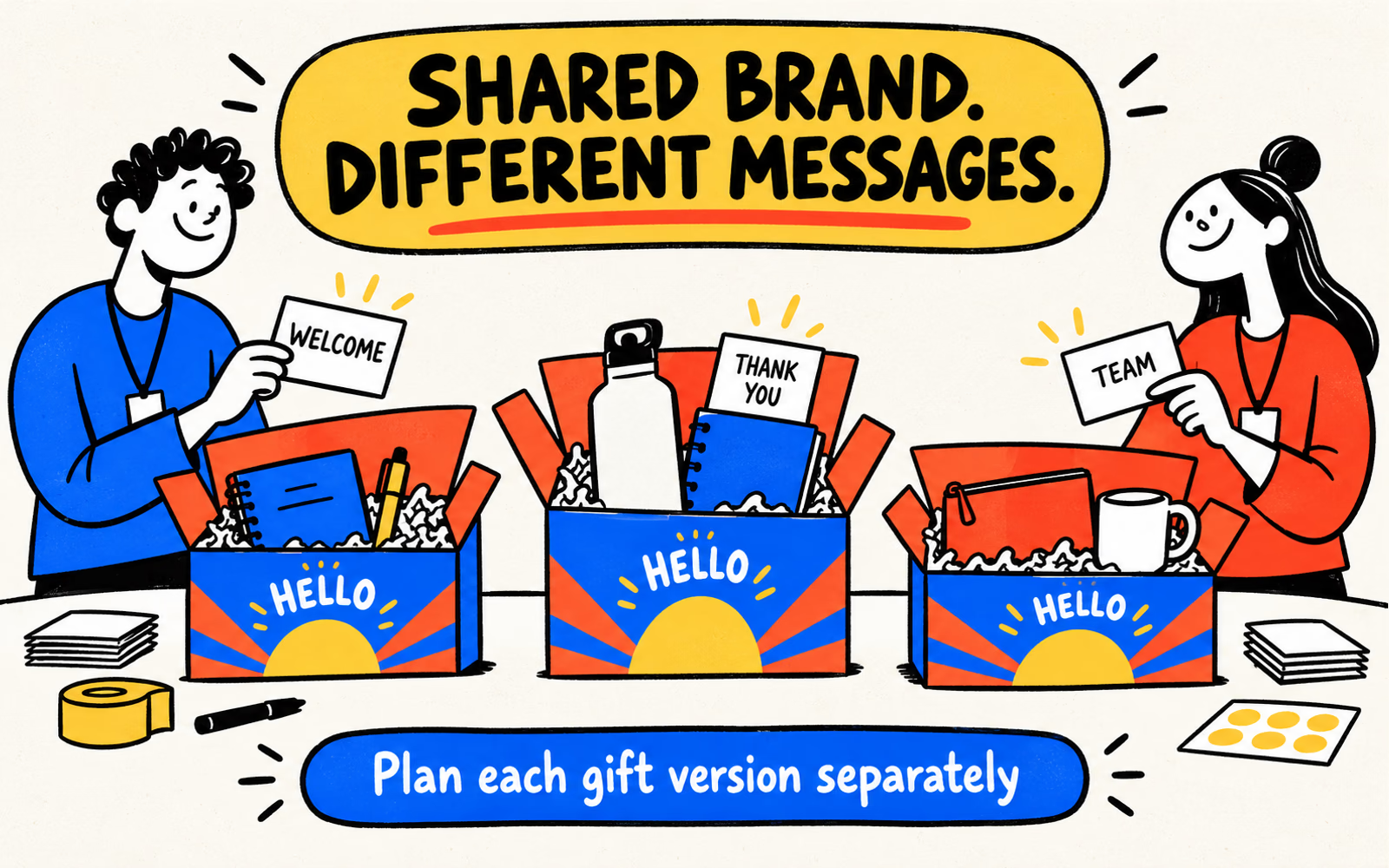
Define the gift contents and recipient groups
Group recipients by the purpose of the gift and the contents they will receive. Use internal group codes rather than personal names in the initial packaging brief. Measure the actual gift arrangement, including each primary pack, any holding parts, and the printed card.
Start with three distinct gift moments
An original example uses a notebook and pen for a welcome gift, a bottle and notebook for a client thank-you, and a pouch and mug for a team gift. These are invented planning sets, not supplied gift products. Their different shapes can require different usable box dimensions.
Record which items are customer-supplied and who is responsible for packing them. Keep the packaging purchase separate from the sourcing of gifts and any proposed assembly service.
Choose what stays the same across the collection
Select a small shared identity: one original mark, one type treatment, and a consistent color relationship. Repeat those elements where they remain visible on the final arrangement. The collection can feel related without using an identical box for every gift.
| Group code | Contents concept | Shared identity | Distinct message |
|---|---|---|---|
| A | Notebook and pen | Blue mark and orange graphic | Welcome |
| B | Opaque bottle and notebook | Blue mark and orange graphic | Thank You |
| C | Small pouch and mug | Blue mark and orange graphic | Team |
The shared identity is artwork, not a compatibility decision. Use the approved layout for each actual structure. A graphic that works on a wide lid may need a different arrangement on a narrower carton.
Review product boxes for presentation and mailer boxes for a proposed outer format. Confirm the job of each component and any holding requirements separately.
Plan personalized printed messages
Write the message around the gift’s purpose. A welcome card can introduce the next step; a thank-you card can acknowledge a specific relationship; a team card can recognize a shared contribution. Keep the wording accurate and natural.
Choose the level of variation deliberately
A different card for each group is one print-version plan. An individual name or message on every card is another request. Do not treat the second as available just because the layout contains a name field. Ask whether the proposed printing method, data workflow, and proof process support it.
Give each approved file a version identifier and quantity. Check any website or QR destination on the actual-size proof. Keep individual recipient data out of reference artwork until there is an agreed process for handling it.
Printed insert cards are message formats rather than structural supports. For writing direction, use thank-you card ideas and adapt the language to your real gift moment. For a campaign-oriented collection, compare PR package ideas; keep your recipient-group plan specific to this gift project.
Prepare quantities and delivery requirements by version
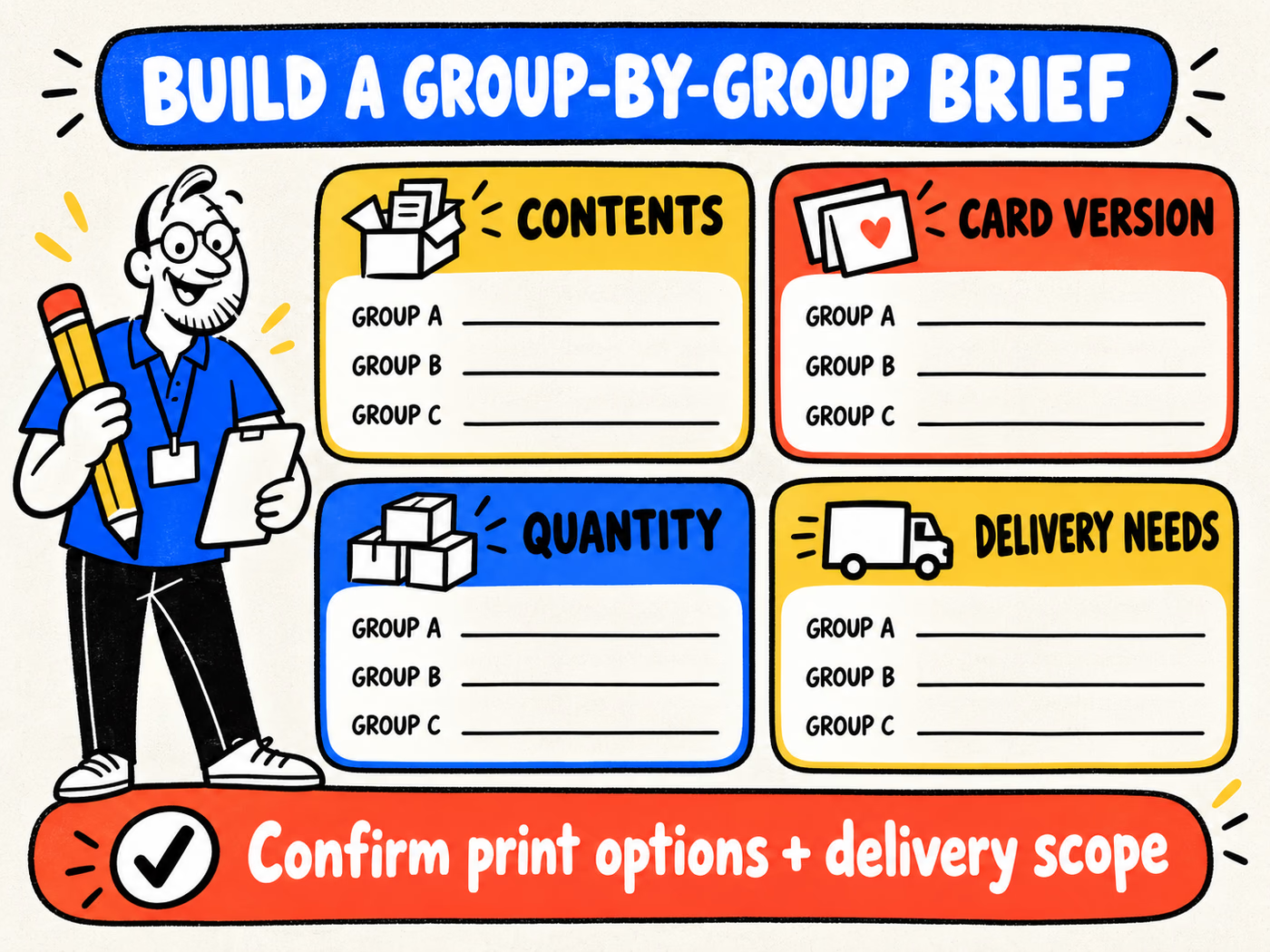
Create a component list for every group: box reference, holding arrangement, card file, and quantity. Count any planned reserve or sample units as a visible assumption. Keep quantities per design separate so the proposal can identify setup and purchasing constraints.
Then distinguish packaging delivery from delivery of completed gifts. A single delivery of empty packaging and individually dispatched packed gifts have different scopes. Ask what is included before relying on a date or destination plan.
| Field | What to record |
|---|---|
| Contents | Actual items, primary packs, and measured arrangement |
| Print version | Approved box and card files; group assignment |
| Quantity | Required units and separate reserve assumption |
| Delivery needs | Packaging destination, requested date, and any separate service question |
Use the box measurement guide and support comparison to prepare the physical brief. Keep gift presentation and transport review connected, while recognizing they ask different questions.
Before approval, reconcile the quantities with the current group list and confirm proof, production, and delivery terms. This plan does not confirm per-unit personalization, gift sourcing, storage, packing, or multiple shipments.
References & planning resources
BrandYourPack’s original planning examples and blank worksheets support project review; they are not completed trials or confirmed supplier terms.