
Starbucks vs. Dunkin’ Cup Sizes: Compare Capacity, Not Just the Name
The same size name can hide different capacities. Compare documented US hot and cold examples, including where a Dunkin’ Medium matches a Starbucks Venti by volume.
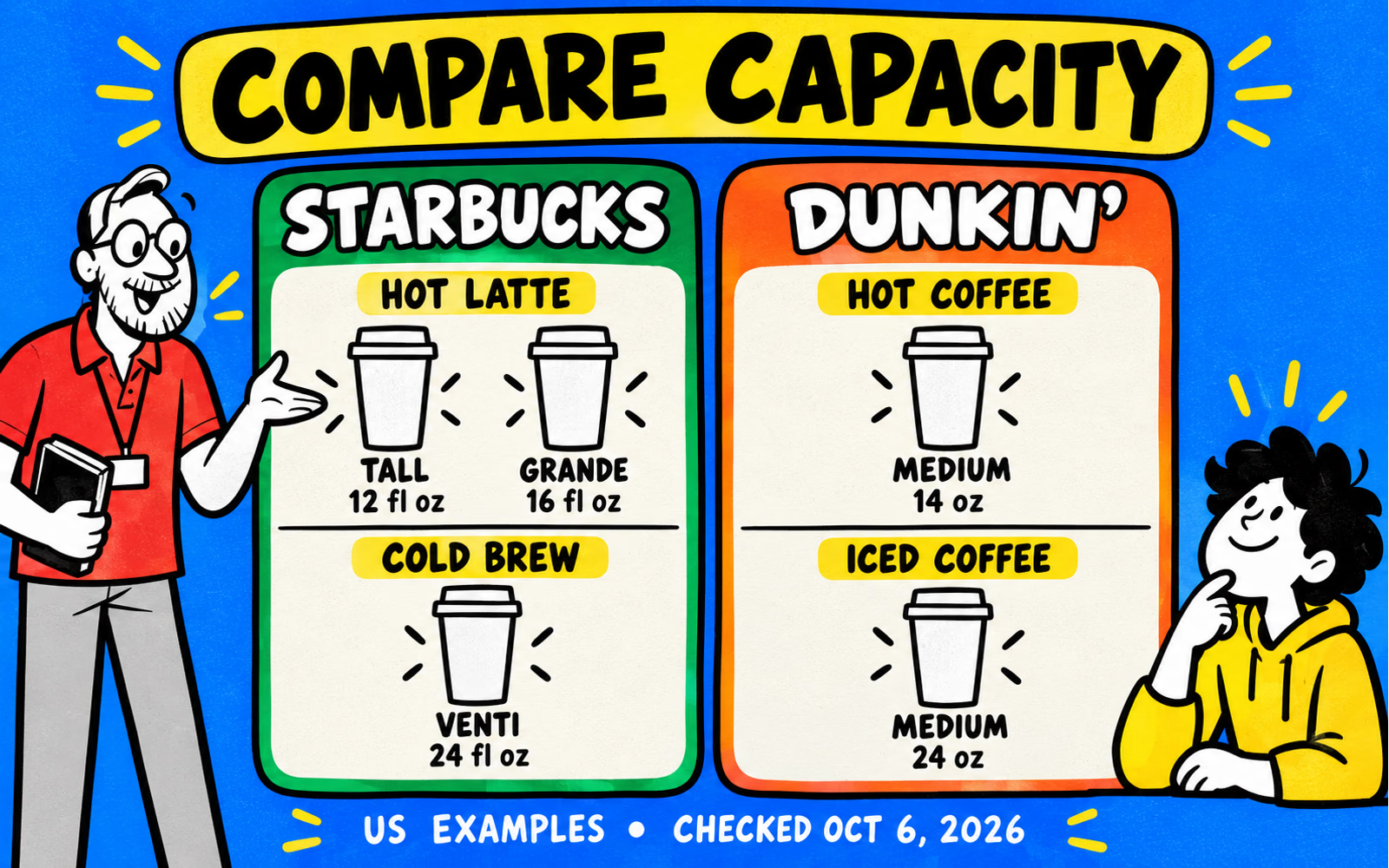
Starbucks vs. Dunkin’ cup sizes are best compared by documented capacity and preparation. The US Starbucks hot Caffè Latte page lists Tall 12 fl oz and Grande 16 fl oz; Dunkin’s June 2026 announcement identifies medium hot coffee as 14 oz. For cold examples, Starbucks Venti Cold Brew is 24 fl oz and Dunkin’ medium iced coffee is 24 oz. That is a stated-volume match with different names, not proof of identical recipes, cup dimensions or lids.
If a customer calls a drink “medium,” the label alone does not tell an independent café what portion they expect. A side-by-side capacity comparison makes the difference easier to explain without adopting another business’s naming system.
Compare like-for-like drinks
Start with the market, preparation and exact menu item. This review uses US Starbucks menu pages checked on October 6, 2026, alongside a US Dunkin’ announcement from June 2026. The announcement explicitly states medium coffee capacities; it does not provide a complete small-to-extra-large chart.
The comparison below is about stated serving volume. A hot latte and a hot brewed coffee are different recipes, just as Cold Brew and iced coffee are different preparations. Their size labels can still illustrate capacity differences, provided those limits remain visible.
| Question | Useful comparison | Do not infer |
|---|---|---|
| Name | Tall, Grande, Venti or Medium | One universal size naming system |
| Capacity | Published ounce label for a named drink | Liquid recipe or caffeine amount |
| Preparation | Hot versus iced examples | That every drink offers every size |
| Packaging fit | Exact cup and lid references | Interchangeable closures from matching volume |
For a full discussion of each menu, use the Starbucks size guide or the Dunkin’ size guide. This article adds the comparison rather than repeating both guides. Check current local ordering availability separately.
Hot sizes side by side
The Starbucks Caffè Latte page publishes Short 8 fl oz, Tall 12 fl oz, Grande 16 fl oz and Venti 20 fl oz. Dunkin’s June 2026 announcement states medium hot coffee at 14 oz. The table places that verified medium beside the Starbucks choices without inventing missing Dunkin’ entries.
| Starbucks hot Caffè Latte | Published capacity | Dunkin’ documented hot coffee |
|---|---|---|
| Short | 8 fl oz | No equivalent established here |
| Tall | 12 fl oz | Medium is larger at 14 oz |
| Grande | 16 fl oz | Medium is smaller at 14 oz |
| Venti | 20 fl oz | No equivalent established here |
The 14 oz medium sits between the 12 fl oz Tall and 16 fl oz Grande in these examples. It does not exactly match either. Calling Grande “the same as Dunkin’ Medium” would erase the capacity difference.
Use that distinction when writing your own menu. A clear portion label helps a customer understand a hot serving without asking staff to translate another chain’s names. This comparison does not establish prices, nutrition or relative value.
Iced sizes side by side
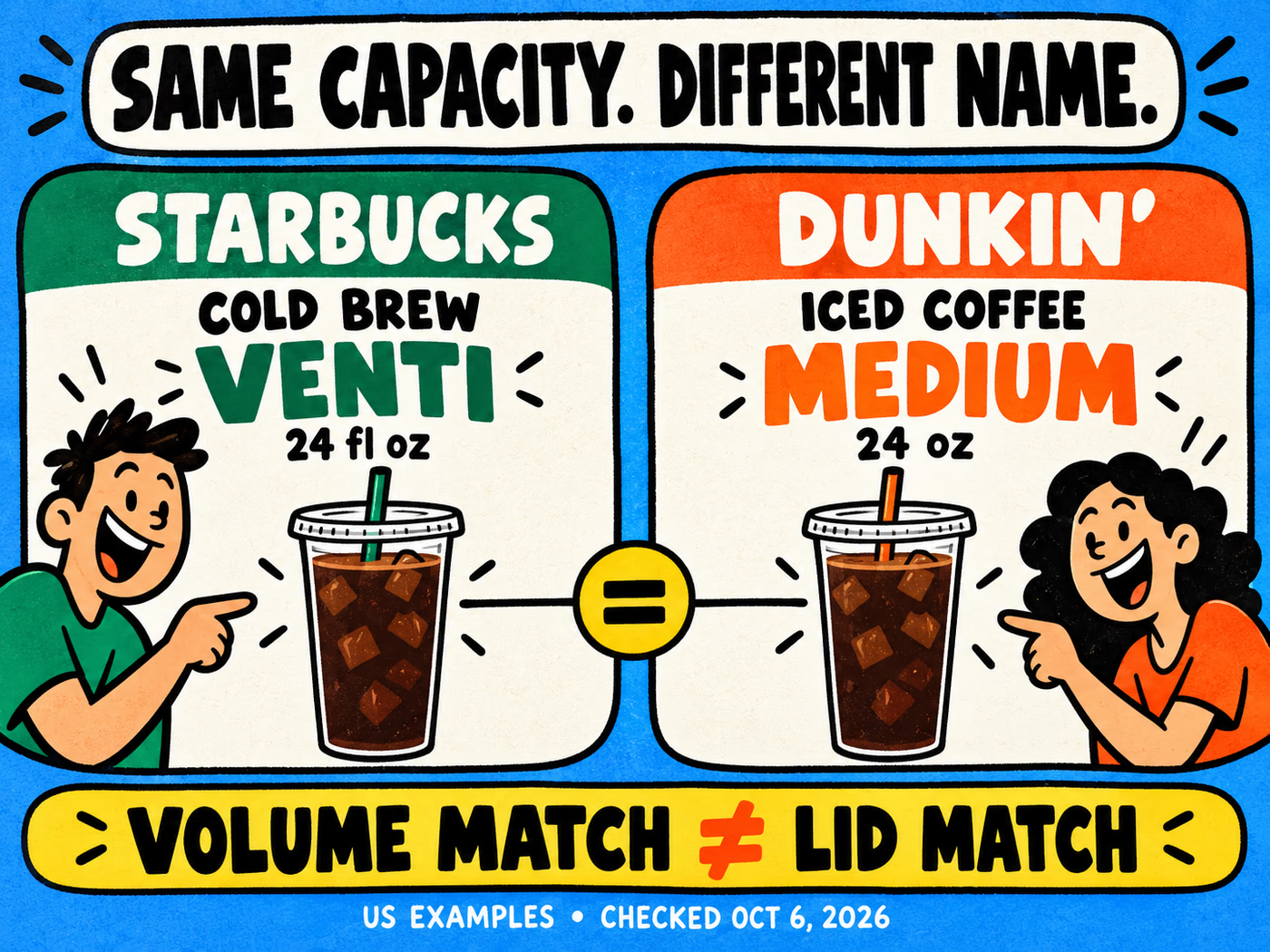
The Starbucks Cold Brew page lists Tall 12 fl oz, Grande 16 fl oz, Venti 24 fl oz and Trenta 30 fl oz. The cited Dunkin’ announcement states medium iced coffee at 24 oz. That gives one documented same-volume pairing: Venti Cold Brew and Medium iced coffee.
| Starbucks Cold Brew | Published capacity | Dunkin’ documented iced coffee |
|---|---|---|
| Tall | 12 fl oz | No equivalent established here |
| Grande | 16 fl oz | No equivalent established here |
| Venti | 24 fl oz | Medium: 24 oz stated volume |
| Trenta | 30 fl oz | No equivalent established here |
The infographic links only that verified pair. The same capacity does not mean the same amount of coffee before ice, the same flavor or the same physical vessel. It also does not establish that Trenta is available for every Starbucks iced drink.
Keep ice and toppings in a separate serving record for your café. Do not derive a supplier’s cup diameter from this chart or order lids against the word “Venti.” Read the cup-and-lid guide for the exact-reference review.
Why cafés should label capacity clearly
Choose names your customers can understand, then connect each name to a specific serving with explicit units. Use separate hot and iced rows if they represent different portions. Staff instructions and supplier orders should point to the same agreed references.
A compact menu might say “Hot latte — 12 fl oz” and “Iced coffee — 16 fl oz” if those are the café’s actual planned servings. These are illustrative menu labels, not a recommendation that those two capacities suit every recipe.
Keep the menu and procurement brief connected
Record the complete drink arrangement, proposed cup and closure, artwork version and quantities by item. Confirm the available capacity specification with the packaging supplier and check the actual cup and lid together. A volume chart answers a different question from a fit review.
Explore paper cups and plastic cups with your intended service use. Review hot-cup constructions where relevant. Keep the choice tied to your menu and operations rather than assuming another chain’s size name is a complete product specification.